

Get in touch
Stay informed
Receive monthly updates on trends, products and growth insights in your inbox.






Heather Hershey, Research Director at IDC, made some bold statements along with a few disconcerting predictions in her keynote, “What’s Coming in the World of Digital Commerce” at Elevate — The Global Commerce Summit™. Her presentation also made a lot of sense. She dove deep into five trends and put a strong focus on how AI currently fits into the digital commerce equation and what to expect in the future.
Regardless of the trend she was presenting, her underlying message was that no matter what strategies you choose to implement to drive your business, it's critical to keep the focus on your customers. “Commerce, like all of business, is fundamentally about relationships. When we talk about technology, don't forget the point of the exercise. We're not just here to build better mouse traps. We're here to build relationships that are durable so that we can futureproof our companies.”
The five trends Heather presented are all things she believes business leaders should consider in thinking about what’s next for their organization. Not only did she explain her rationale for choosing each trend, but she also provided statistics to reinforce its relevance and guidance on how to embrace the trend. She also made it clear that investing in modern technology is critical for businesses looking to thrive in today’s digital commerce environment, stressing the importance of choosing a flexible solution that enables experimentation.
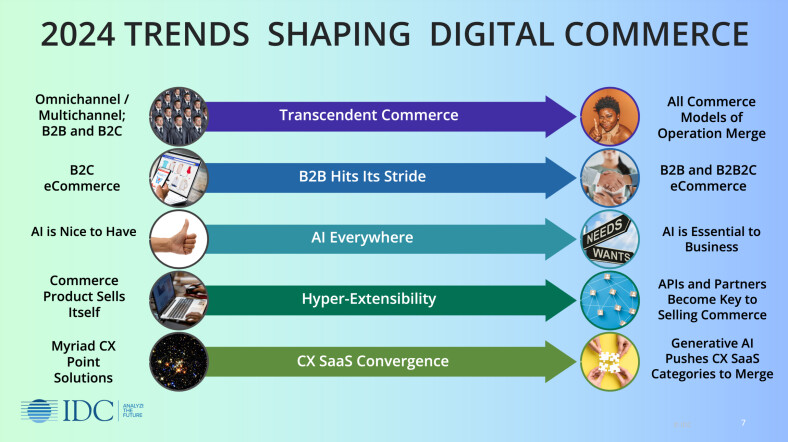
While unified commerce emerged as a buzzword this year, Heather doesn’t feel the term adequately describes the experience businesses should strive to deliver to customers. While she acknowledged that the word conveys the idea of tying disparate systems together to create continuity and deliver more seamless experiences, she pointed out that customers don’t really care about how you are unifying your commerce.
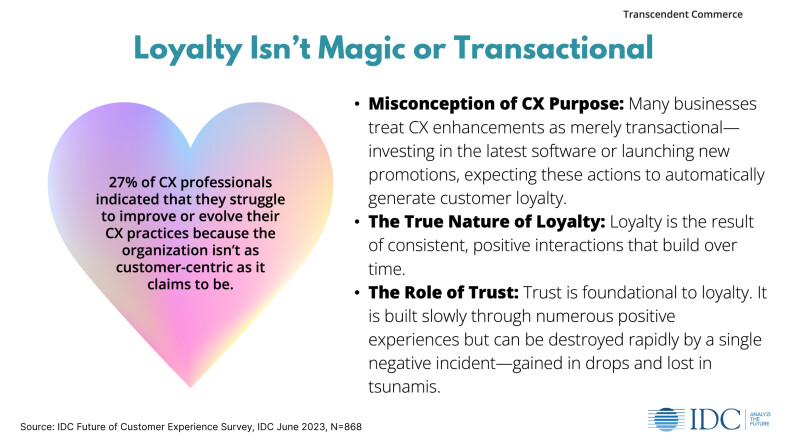
In Heather’s opinion, the concept of unified commerce isn’t customer-centric. On the other hand, transcendent commerce, as she defines it, goes beyond business strategies, encompassing empathy as a critical factor in building successful digital commerce. She pointed out that the more AI becomes embedded in commerce operations, the more critical it becomes for businesses to exhibit empathy, not just toward customers but also with employees. After all, humans are what fuel commerce.
While IDC research shows that 8.9% of B2B firms say they are “not a digital business” and 41.3% identify as “somewhat of a digital business,” Heather said the “sleeping giants” of B2B are finally waking up and starting to embrace digital commerce. She sees this shift as a huge opportunity for both B2B players and technology vendors. In this new environment, she predicts that B2B2C commerce will become more of the norm with AI playing a critical role in driving revenue.
With over two-thirds of buyers reporting that they expect to work less with salespeople in the next two years, instead using digital more to help with complex buying decisions and make purchases, B2B organizations need to turn to AI-guided purchasing experiences. Heather pointed out that these capabilities exist today and can support buyers who choose digital as the starting point for the discovery process. However, she cautioned that B2B organizations need to figure out when the handoff needs to occur. “Recognize that nuance needs to be a part of that. Where are the limits of AI? Bring a human into the loop without manual escalation involved.”
AI was the biggest trend of 2023 and 2024, and Heather believes that thus far what we’ve seen is only the tip of the iceberg. She explained that currently, generative AI technology can only pull from known data, which includes bad data, and delivers a lot of hallucinations. She advised the audience to consider “AI as a tool to free internal teams to focus on the human elements of their work and authentic engagement that AI cannot currently duplicate — and may not ever really be able to duplicate.”
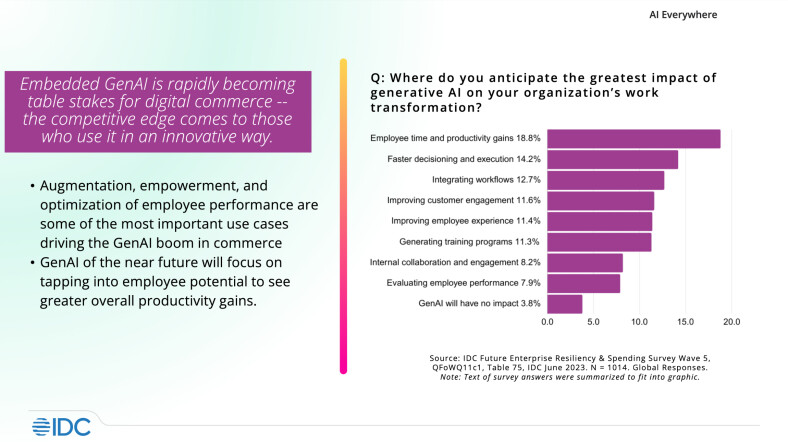
Heather predicts that generative AI technology will continue to grow at an exponential rate and ultimately lead to the emergence of Artificial General Intelligence (AGI) by 2029. She cited Ray Kurzeil, a futurist and Google AI engineer, who has written multiple books on the topic, as validation. She feels that the real disruption will begin when this happens because AGI doesn’t need a human operator to provide direction. “This is the kind of AI that will make most of us in this room obsolete because it is capable of doing its own context. It’s capable of reasoning and self-moderation — it will be able to solve its own problems.
While she cautioned that AGI will jeopardize more jobs, she said humans will always be needed because customers will still be humans. “You have to have empathy for them, and that's going to become more important as they become more precious, harder to find and harder to keep.”
Many technology vendors have already embedded GenAI features into their products to support heightened customer experiences (CX) and those that haven’t are working on doing so. This strategy is blurring the lines between digital marketing and commerce technology. In fact, an IDC survey found that 73.9% of business leaders sense that the two are converging. Comments ranged from, “The two working in tandem is absolutely a requirement at this point” to “We have the same team working on both commerce and marketing internally.”
This trend makes it even more important for business leaders to involve their tech teams in technology buying decisions, because as Heather explained, otherwise, you can end up with products with redundant feature sets. “If you don’t know how to ask the questions or even what questions to ask, bring a technologist along with you. Far too often when these decisions are being made, you leave the CTOs and the engineering people out of the loop and the C-suite makes these decisions in a vacuum. We need to advocate for technologists to be more involved.”
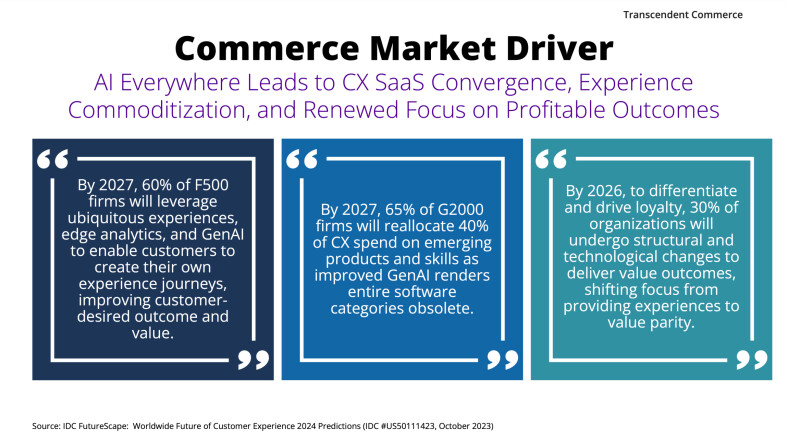
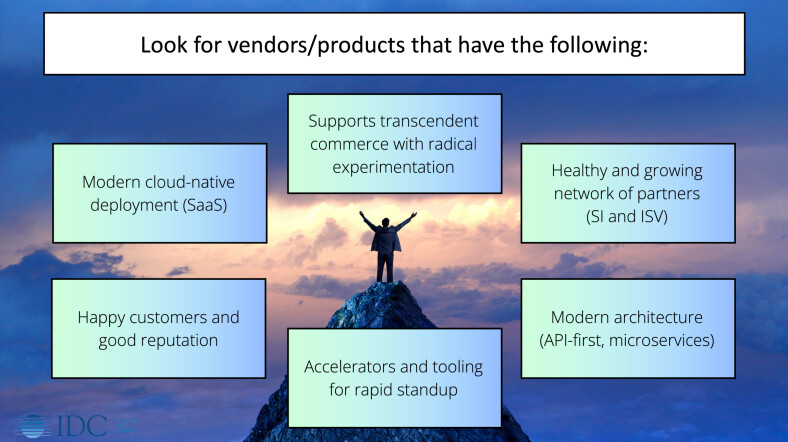
In the beginning of her presentation, Heather promised to, ”tie everything together with a neat little bow.” This is exactly why she chose hyper-extensibility, i.e. the flexibility of your technology, as the final trend. Basically, the speed of evolution in commerce today demands that you can enable rapid experimentation and rapid replacement. This, she says is the only way for businesses to move quickly to adapt to change.
She advised that businesses “seek commerce SaaS with a flexible data model” and look for “unopinionated, API-agnostic technologies.”
To watch Heather’s presentation and gain access to videos of all the keynotes from Elevate — The Global Commerce Summit™, visit the Elevate Keynote Replays landing page.

Anita J. Temple is the Corporate Journalist at commercetools. She was a fashion editor at Women’s Wear Daily (WWD) and W Magazine before launching a career as a freelance writer and creative producer. She has written content and worked on a wide range of marketing projects for companies including Dreamworks, Walmart, Coca-Cola, Verizon, and Adidas.
Receive monthly updates on trends, products and growth insights in your inbox.