


Get in touch
Stay informed
Receive monthly updates on trends, products and growth insights in your inbox.






AI agents are beginning to autonomously discover products, compare options, optimize purchases and even complete transactions on behalf of users, with traffic from generative AI and agent‑driven interfaces driving a 4,700% surge in traffic to shopping sites in the US.
The opportunity is here — but there’s a catch: AI doesn’t fix poor infrastructure. It amplifies it.
In 2026, the most compelling thing about artificial intelligence isn’t the technology itself — it’s what AI exposes about the systems beneath it. Beyond shiny demos and productivity gains, AI shines a spotlight on an organization’s true readiness: How well its data flows, how resilient its systems are and whether its foundational plumbing can actually support autonomous commerce at scale.
If your product data is inconsistent, AI agents make unreliable recommendations. If fulfillment systems are siloed, agents execute in fragments. If checkout and loyalty are disconnected, AI merely accelerates abandonment. A recent survey revealed that many retailers are feeling this strain:
In addition, McKinsey found that 71% of merchants reported AI merchandising tools deliver limited to no measurable business impact, not because the technology fails, but because the underlying systems are fragmented, unstructured and inconsistent.
The enterprises poised to succeed in agentic commerce are investing in foundational readiness: The systems, architecture and data discipline that let AI, humans and redesigned workflows operate with coherence, reliability and trust.
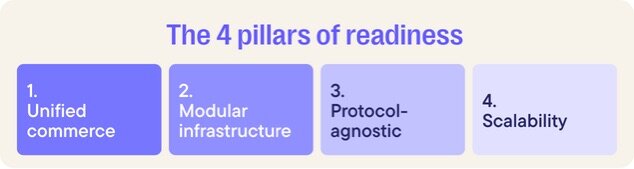
At the heart of every great experience — digital, physical or agentic — is trustworthy data. This means real‑time, structured, machine‑readable information that can be reliably consumed by systems and agents.
AI agents can only act on the data they can interpret; if product catalogs are incomplete, images are missing alt text, prices aren’t synced or inventories lag by minutes, the agentic experience collapses into guesswork. In the agentic era, product content is currency: Structured attributes, enriched descriptions, reviews and real signals that agents can parse and act upon.
The urgency is already visible in the broader experience gap: 65% of retailers admit their current technology stack doesn’t enable the customer experience they want and need to deliver.
That’s why unified commerce has become a business imperative, so much so that businesses already leveraging it are growing 3X faster than those lagging behind.
What unified commerce looks like in practice:
When data is truly unified:
In short, when brands and retailers centralize data, they can unlock agentic capabilities more quickly and efficiently.
If unified commerce is the data foundation, modular infrastructure is the execution fabric.
This is particularly true in the implementation of agentic workflows, as AI agents rely on real-time responses to check prices, validate inventory, create carts, apply promotions and place orders. Modular APIs provide the resilience agents require. Monolithic systems, on the other hand, introduce latency and increase the risk of failure.
That’s why modular building blocks connected by well‑designed APIs have become a strategic imperative, so much so that 94% of enterprises that have fully implemented a composable infrastructure report that their architectures accelerate AI deployment.
API‑first principles include:
This modular approach supports more than agentic commerce; it empowers every part of the business, including loyalty systems, responsive in‑store experiences, real‑time personalization engines, and more.
As agentic commerce matures, multiple standards are emerging. Rather than betting on a single protocol, future‑ready systems support an ecosystem of standards that together enable discovery, context, transactions, and cross‑system integration.
The key protocols shaping agentic commerce today:
These protocols are not competitive — they’re complementary. A retailer may use MCP for broad agent compatibility, ACP for integrations within OpenAI and UCP to interoperate with Google’s agentic ecosystem. Supporting a layered approach abstracts complexity and enables brands to innovate faster without rebuilding for every emerging standard.
Whether the agent’s purpose is back‑office analysis, customer‑facing purchases or fully autonomous purchasing, the right blend of protocols ensures security, interoperability and predictability at every stage.
AI agents query inventory at scale, compare prices across variants, validate fulfillment options and execute transactions in milliseconds. At the same time, human shoppers are still browsing, streaming content, checking store availability and engaging with loyalty programs. These two forces converge on the same infrastructure. Systems built for predictable, human-paced traffic quickly strain under hybrid demand.
The shift is already visible during peak commerce moments. The 2025 Black Friday–Cyber Monday (BFCM) weekend was one of the first large-scale stress tests of AI-driven shopping traffic. On Cyber Monday alone, retailers saw a 670% surge in traffic from AI channels.
For commerce platforms, this introduces a new operational reality. Instead of predictable traffic patterns driven by human browsing behavior, systems now face bursts of machine-generated queries: Agents validating availability, checking multiple product variants, comparing prices across retailers and orchestrating purchase decisions on behalf of users.
Scalability in this environment requires more than simply adding servers. It means designing infrastructure where:
Whether the interaction begins with a human shopper or an autonomous agent, the expectation is the same: Immediate, accurate and frictionless execution. Retailers that build elastic, modular and event-driven systems create the operational resilience required to compete in a world where commerce never sleeps — and where AI agents may soon become some of their most active customers.
AI reflects the strengths and weaknesses of your systems back at you at machine speed. Organizations with unified data, modular APIs, cross‑protocol interoperability and scalable infrastructure don’t just enable agentic commerce — they unlock better human‑facing experiences, faster innovation cycles and more resilient operational models.
The future belongs not to those who adopt AI first, but to those who lay the foundation that enables AI to deliver value.

White Paper
Navigating the Agentic Commerce Era On Your Terms
The practical guide to help you approach agentic commerce strategically — not out of FOMO.

Manuela leads content strategy at commercetools. With over 20 years of experience in B2B SaaS, she writes about all things commerce by day and turns to fiction by night. She loves long walks, traveling, and, unsurprisingly, reading books.
Receive monthly updates on trends, products and growth insights in your inbox.