


Get in touch
Stay informed
Receive monthly updates on trends, products and growth insights in your inbox.





B2B sales growth strategies have seen a renaissance over the last couple of years, driven by the automation of buyer interactions for repetitive tasks through eCommerce and now with AI entering the arena.
However, not everything can be fully automated to replace the critical role that humans play in B2B sales scenarios. In a marketplace known for its inherent complexity, it’s often the sales rep with expertise and a long-standing relationship who can step in to save the day. Or, more specifically, the deal.
There are various factors that emphasize the need for human-based touchpoints:
While the share of revenue from digital channels continues to increase, sales and customer service reps remain indispensable in an environment where complexity is multiplying.
Leading B2B organizations have recognized that digital channels don’t replace sales reps — they augment them. The most successful companies are empowering their teams with technology that helps them navigate complexity faster, deliver more accurate recommendations and engage customers more effectively across channels. This hybrid sales approach, combining both human and digital (including AI) touchpoints, will continue to increase across manufacturers, distributors and wholesalers.
This is where assisted selling capabilities become a critical pillar of hybrid sales in B2B commerce.
Assisted selling is a B2B eCommerce capability that enables sales and customer service representatives to “act on behalf” of buyers during the purchasing process.
Rather than relying solely on self-service interactions, sales reps can step into a customer’s cart or session to:
Once the changes are finalized, the updated cart can be handed back to the customer for review and order placement.
In complex B2B environments, assisted selling bridges the gap between digital commerce and human expertise, combining the efficiency of eCommerce with the flexibility and expert support of a sales representative.
As B2B commerce becomes increasingly hybrid, businesses need a way to seamlessly combine self-service buying with expert human guidance. Assisted selling with commercetools enables sales and service representatives to act on behalf of buyers during critical moments in the purchasing process — whether to resolve complexity, accelerate conversions or provide tailored support.
Before diving into the capabilities themselves, it’s important to understand the operational layer that enables them in practice: The commercetools’ Merchant Center.
The Merchant Center is the central user interface (UI) used by sales, customer service and operations teams to manage commerce activities. It serves as the control panel for assisted selling, providing authorized sales and customer service reps with a secure workspace to view active customer carts, access order details and perform actions on behalf of buyers. From this interface, representatives can step into ongoing transactions, make necessary adjustments, and coordinate complex purchasing scenarios without switching between disconnected systems.
commercetools’ Assisted Selling enables sales reps to assist buyers by performing parts of the purchase process:
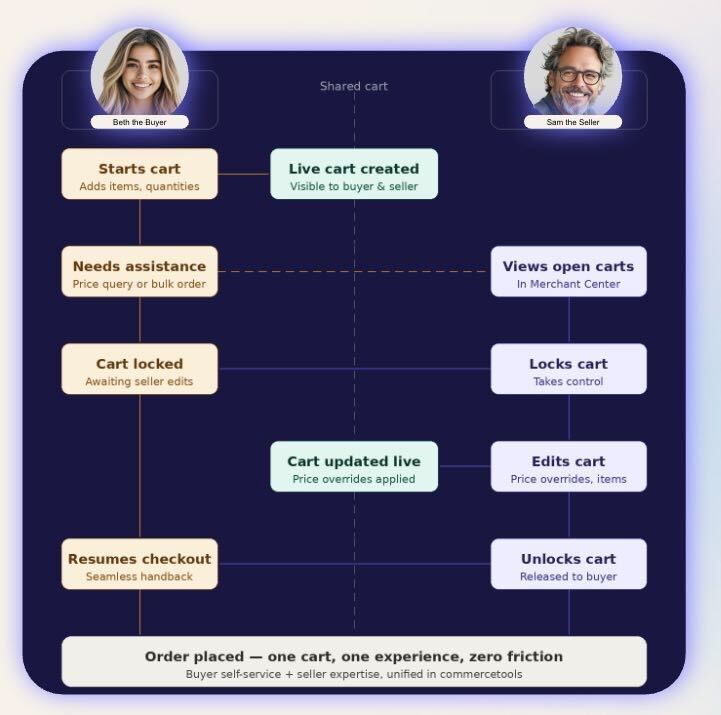
commercetools’ Assisted Selling works in two main steps:
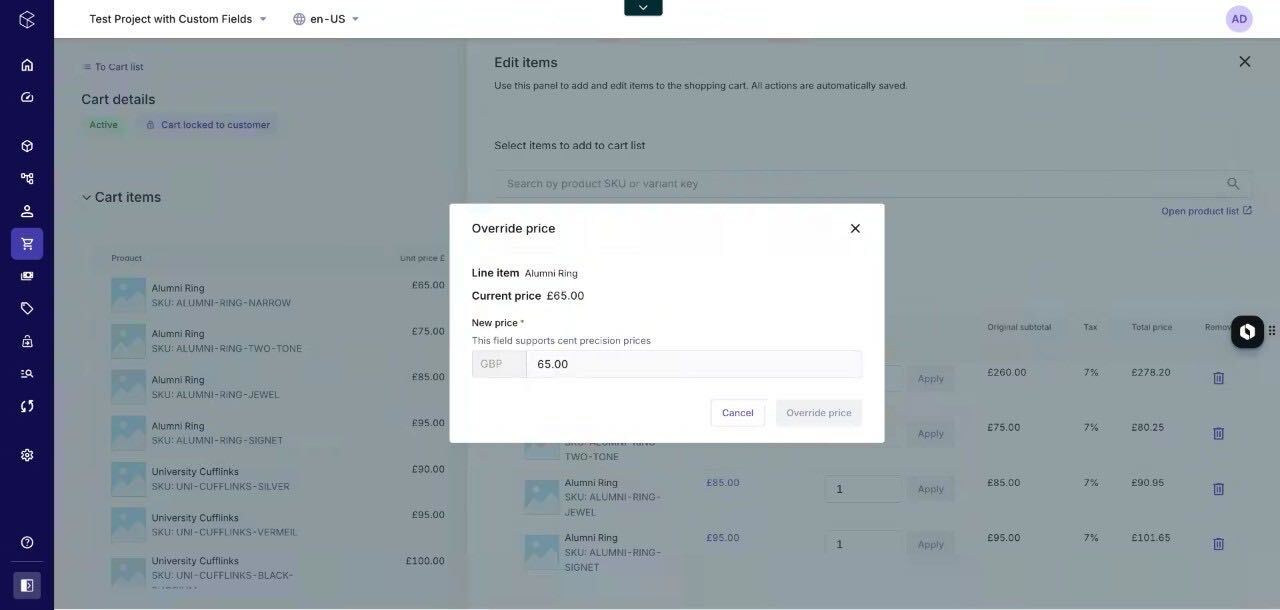
Sales and support representatives can securely view, pick up and amend customer carts in real time. While operating in “Locked Mode,” authorized sellers can add or remove products, adjust quantities, override pricing, apply discounts or promotions, and configure complex orders or product combinations.
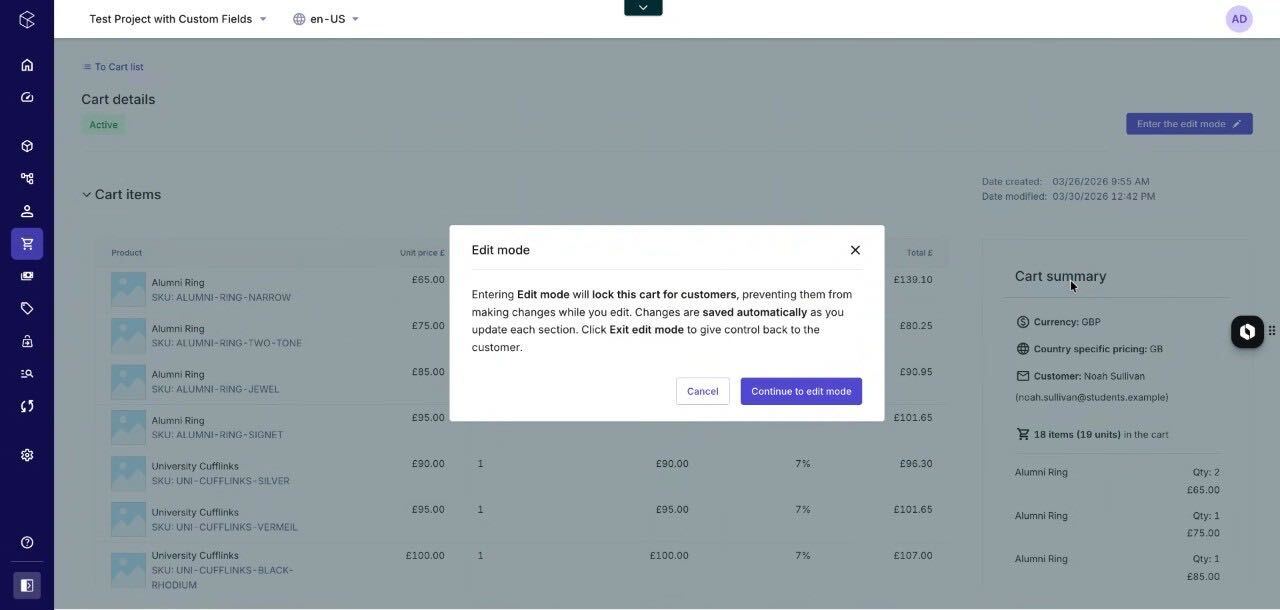
Assisted selling is designed to complement (not replace) digital self-service. While a cart is locked, only the authorized representative can make changes. Once updates are complete, the cart can be returned to the customer via event-driven notifications and configurable triggers, allowing the buyer to review and complete the purchase independently.
Assisted Selling is designed to remove the traditional trade-off between flexibility, scale and control in B2B digital commerce, enabling businesses to support complex customer journeys while staying future-ready for AI and omnichannel growth.
Assisted selling enables B2B-selling organizations to support high-value or high-complexity transactions without forcing customers to restart the buying process offline. It creates a frictionless collaboration model where customers and sales representatives work within the same transaction journey, combining the convenience of self-service commerce with the flexibility of human support.
This hybrid approach is especially valuable for complex product configurations, negotiated pricing, entitlement checks or multi-stakeholder procurement workflows that require manual intervention. This translates into two main benefits:
Empowering sales and customer service representatives to intervene during checkout helps businesses reduce cart abandonment and recover revenue that might otherwise be lost.
Teams can:
This directly helps increase conversion rates, average order value (AOV) and customer lifetime value (CLV).
Looking into the future, because the Assisted Selling functionality is built on the extensible commercetools platform, these same cart and checkout capabilities can also support the future of B2B sales through AI-driven commerce experiences and autonomous sales agents.
Assisted selling also reduces operational overhead by eliminating the need for disconnected custom tools and manual workflows.
Instead of relying on separate systems for cart support and order management, businesses can provide sales and support teams with native tooling directly within the Merchant Center. This helps organizations:
The result is a more scalable and efficient approach to human-assisted commerce and a more seamless customer experience.
With commercetools B2B Commerce, Assisted Selling is available out of the box, enabling businesses to get started quickly without building custom tools or stitching together disconnected systems. Teams can immediately begin supporting customers inside active carts, resolving issues in real time and guiding complex transactions through to completion.
This means businesses can start:
If you’re ready to bring human expertise directly into your digital commerce flows, contact our team to learn more.
B2B businesses can speed up sales cycles by combining self-service commerce with human support. Assisted selling helps sales teams resolve pricing, product or checkout issues in real time, reducing friction and helping deals close faster.
The most effective B2B sales approach is a hybrid model that combines digital self-service, AI and human expertise. This allows businesses to support complex buying journeys while improving efficiency and customer experience.
Assisted selling is a B2B commerce capability that allows sales and service teams to act on behalf of buyers during the purchasing process, including updating carts, configuring products and adjusting pricing.
Assisted selling helps reduce cart abandonment by allowing sales reps to resolve issues, apply custom pricing and guide buyers through checkout. This can increase conversion rates, AOV and customer lifetime value.

With over a decade of experience across product and marketing teams in the tech world, Julia specializes in creating innovative, customer-first strategies and driving cross-functional growth and go-to-market initiatives.

Anastasia Drougka is a Staff Product Manager at commercetools. She has 10 years of experience in eCommerce and has worked with a number of different industries across the globe as an eCommerce specialist.
Receive monthly updates on trends, products and growth insights in your inbox.