

Get in touch
Stay informed
Receive monthly updates on trends, products and growth insights in your inbox.




For years, the narrative around AI in B2B commerce has been dominated by one question: Will AI replace sales?
The short answer is a resounding no. But the more interesting answer is: AI is fundamentally reshaping sales.
For starters, today’s B2B buyers aren’t choosing between AI or human interaction. They expect both to work together seamlessly without visible channel transitions, repeated information or friction. Buyers expect automation from simple eCommerce journeys while preferring to speak to a sales rep when deals become too complex.
Sellers, on the other hand, often see AI as a cost-saving mechanism to reduce support burden or cut manual work. While this is true, it’s too narrow a perspective. Sales reps who look beyond the surface can see that AI is fundamentally changing the selling process:
Buyers are also adopting AI: 86% of Gen Z professionals use AI daily at work, primarily for product research in B2B buying.
So much is clear: This shift has a direct impact on revenue, customer relationships and competitive differentiation.
At this point, AI can help automate repetitive tasks, but it can’t act on its own. When trust, creativity, brand experience and empathy are required, the human touch remains critical, especially for complex or strategic purchases. For example, while AI works exceptionally well on how buyers discover products, interacting with sales reps enables a final validation of orders, relationship building and exception handling in complex deals.
But while the promise of AI is undeniable, reality tells a different story: Not all AI tools are ready for prime time. Let’s take a closer look at where agentic AI stands today.
There’s no denying that agentic AI — autonomous systems capable of handling tasks without continuous human input — is developing at breakneck speed, but the technology is still in its early stages. This was recently illustrated when OpenAI paused the Instant Checkout feature in ChatGPT. Test results from Walmart showed that conversions completed directly within the ChatGPT agent were three times lower than when users clicked through to the American retailer’s website.
Consumers are increasingly comfortable with AI discovering products for purchase or comparing options, and trust in autonomous shopping isn’t as far-off a reality: 53% of European consumers are comfortable with letting AI manage recurring purchases automatically. The figure may not look high at first glance, but given that agentic commerce isn’t mainstream just yet, it marks a significant shift in consumer behavior.
This also highlights a crucial difference between B2C and B2B. With complex business orders, trust and accountability carry more weight than with an impulsive consumer purchase. B2B organizations often require a sales rep to perform a final check before an order is confirmed, simply because the impact of a mistake can be greater, especially in regulated industries.
While many approval flows and assisted selling will leverage AI to improve operational efficiency, they’re likely to require a “human-in-the-loop” approach.
That said, while AI — and agentic AI in particular — is taking off in consumer-facing sectors, the reality in B2B is not only different but also more complex. What I often heard at a recent gathering of 20+ commerce leaders in the Netherlands was something like this: “We are experimenting with AI, but our organization is just not ready for it yet.” It summarizes the current state of AI for B2B organizations quite well.
What is changing rapidly is how buyers find what they need — and that perfectly meets the needs of B2B buyers looking for hyper-specific items.
Even before AI-powered search became a thing, product discovery in B2B wasn’t focused on keywords, as was the case with traditional retail searches. In fact, conversational commerce in B2B is even more crucial, as discovery often starts with questions like, “Which part fits this machine and can be delivered tomorrow?”
More often than not, those questions were answered by human reps with encyclopedic knowledge of the products they sell (and by checking multiple internal systems of record for inventory availability). This is the kind of use case that’s perfect for AI: With comprehensive, machine-readable product data available, it’s easy for AI channels like ChatGPT to display the right information — or for B2B organizations’ own AI-enabled customer service to answer such questions without human intervention.
If that information is missing or unclear, however, there’s a risk of incorrect results being shown, or even products from a competitor being suggested.
AI can guide buyers to the right products, but discovery alone isn’t enough. The real revenue impact comes when AI can turn that insight into action, making the buying process smarter, faster and more profitable.
The tipping point at which AI genuinely contributes to revenue growth lies at the intersection of information and action. Once AI is connected to real-time pricing, customer-specific contract terms, order history and current stock levels, two things occur simultaneously:
For large distributors with enormous numbers of SKUs and inventory positions, this can be tremendously effective.
Reducing friction and boosting upsells directly affect a customer’s lifetime value. In practice, a well-configured AI agent can increase the wallet share with existing customers from 5 to 10 percent. In the B2B market, where customer retention is often more profitable than acquisition, AI thus serves as a powerful tool for selling more, becoming a significant revenue driver rather than just an operational efficiency driver.
As AI capabilities evolve, one strategic risk is becoming increasingly clear: Vendor lock-in.
Many traditional platforms are embedding AI directly into their ecosystems. While convenient, this approach can limit flexibility, locking companies into a single model or vendor at a time when innovation cycles are accelerating. Given the pace at which new AI models are succeeding one another, architectural flexibility is crucial.
A more future-proof approach is architectural separation:
This modular architecture allows organizations to use different AI models side by side for specific tasks. The advantages are clear:
With the right architecture in place, organizations are ready to unlock tangible results.
The real value of AI often comes from a combination of small improvements that make the buying process frictionless. For B2B organizations exploring AI capabilities, this means three steps they can take today:
AI is only as good as the data it can access. Focus on product information and inventory information, pricing logic and relationships between SKUs. Importantly, ensure this data is structured in a way that AI models can interpret and use effectively.
Map your buying journey and ask:
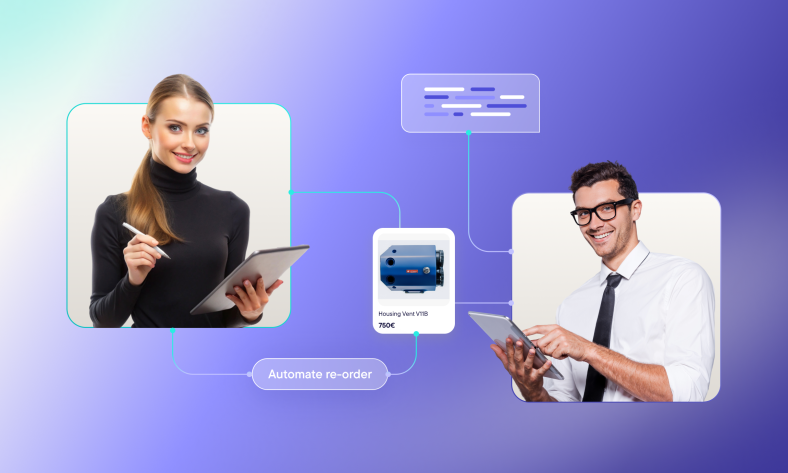
Automating the transactional layer, especially repetitive tasks, creates immediate gains.
Choose API-first, modular solutions that allow you to adapt quickly. The AI landscape is changing too fast to commit to rigid systems.
When implemented thoughtfully, these strategies do more than improve efficiency; they create a superior buying experience. And in B2B commerce, experience is everything.
In B2B, the winner has never been the company with the lowest price, but the one that makes buying from them the easiest.
According to Dentsu, professional decision drivers — product information, clarity, speed and trust — dictate whether buyers choose, remain loyal to or switch suppliers. Unsurprisingly, B2B leaders who focus on getting the buyer experience just right close deals 31% faster, highlighting the tangible business impact of digital excellence.
This is where AI enters the scene — not as a gimmick, but as a transformative enabler. Dentsu estimates that 77% of all B2B buying processes used AI in 2025, and that the proportion of heavy users grew to 40%. Forrester reports similar findings: 89% of B2B buyers have adopted generative AI as one of the top sources of self-guided information throughout every phase of their buying process.
In other words, the B2B enterprises that succeed will be those that can:
At the end of the day, B2B buyers care about one thing: A frictionless and fast customer experience. For B2B sellers to achieve this, the question isn’t about replacing everything with AI or sticking to the human-only way of selling. It’s about leveraging both effectively.

White Paper
B2B Commerce Buying Guide
Get the guide to help you evaluate requirements and capabilities for modern B2B commerce platforms.

Derk-Jan helps companies build modern commerce platforms, working closely with customers, partners and tech teams. Based in the Netherlands, he aligns teams, asks the tough questions and turns polished slides into measurable results — no fluff, no fairy tales, just scalable eCommerce.
Receive monthly updates on trends, products and growth insights in your inbox.