


Get in touch
Stay informed
Receive monthly updates on trends, products and growth insights in your inbox.



.png)

Search has quietly become one of the most powerful economic forces on the internet — not only because it drives traffic, but because it captures intent. When search works, it compresses the distance between discovery and decision. When it fails, it directly leaks revenue, as users frequently abandon an eCommerce site after a poor search experience.
Now, bring that dynamic into B2B — and the stakes get even higher. B2B buying journeys are longer, more complex and increasingly digital-first. Now, more often than not, buyers start their discovery journey with online searches rather than sales reps.
B2B search data reveals that 89% of B2B researchers use the internet during their process, and 71% begin with a generic (non-branded) search query. On average, they perform around 12 searches before engaging with a specific vendor. In other words, search is not just part of the journey — it is the journey.
What makes this especially urgent is that B2B organizations have historically underinvested in search compared to B2C, relying on their existing customer relationships — and the gap is clear. B2B eCommerce sites still underperform significantly in search experience, scoring 1.3x lower than B2C sites in key functionality benchmarks.
For instance, many B2B enterprises still work with product search APIs without semantic capabilities, relying on exact keywords, SKUs and rigid filters. This means buyers must already know how products are labeled to find them.
However, this isn’t always the case in B2B purchasing journeys, especially when buyers are looking for spare parts based on function, usage context or incomplete technical information rather than exact SKUs or catalog terminology. This limitation forces them to guess the right phrasing or manually navigate complex hierarchies just to identify the correct item.
An added element of confusion is that the codes and labels for a given product or part within a buyer’s ERP or inventory management system likely don’t match the codes and labels within the manufacturer’s system or buying portal.
Beyond the B2B buying experience, priorities are shifting fast: 83% of B2B sellers now prioritize AI-powered search, recognizing it as core infrastructure for guiding complex decision-making and unlocking revenue at scale. Most importantly, discovery is shifting toward AI-assisted and conversational channels that expect structured, semantically rich product understanding.
For manufacturers, distributors and wholesalers, it’s crucial to unlock intelligent discovery that’s deeply integrated into the product catalog data model. That’s where commercetools comes in.
Five years ago, keyword-based search was often “sufficient” in B2B. Today, users are shaped by AI-native, intent-aware experiences from the likes of Google, Amazon and ChatGPT. As a result, product search APIs that cannot handle natural language, synonyms or vague queries cannot meet today’s expectations.
This becomes especially clear across the buyer journey, where intent rarely aligns with catalog structure. Users don’t start with SKUs or internal taxonomy; they start with problems or use cases, such as “industrial pump for corrosive liquids,” “replacement seal for high-pressure system,” or “compatible spare part for legacy equipment.” At this stage, they often don’t know the exact product name or attribute values the system expects.
Where search breaks today is in translation between intent and data:
The result is friction: Zero results, irrelevant listings and repeated query reformulation. In complex B2B catalogs, this often forces users to resort to manual filtering or even to offline support channels just to identify the right product, extending the timeframe from product selection to transaction.
Semantic search addresses this by shifting from keyword matching to meaning. Instead of relying on exact terms, it interprets intent through semantic relationships:
Under the hood, this is powered by semantic embeddings that capture meaning-based similarity rather than literal overlap. From the user’s perspective, it simply means they can describe what they need in their own words and still get relevant results.
In B2B, this matters at every stage where intent, context and ambiguity outweigh exact keywords — from query formulation to ranking to zero-result recovery. At scale, that difference determines whether digital search becomes a revenue driver or a source of friction.
commercetools’ Storefront Search API is the discovery engine that transforms catalog data into fast, relevant product experiences across storefronts, apps and AI-driven shopping journeys.
For B2B in particular, our Storefront Search API accelerates procurement with an intelligent, fast search that respects B2B-specific product entitlements, negotiated pricing and complex filtering needs for effortless discovery that supports a parameter mode with three options:
Here’s a practical example:
Merchants have full control over which mode is selected, and all existing filters, facets, sorting and pagination work unchanged regardless of mode.
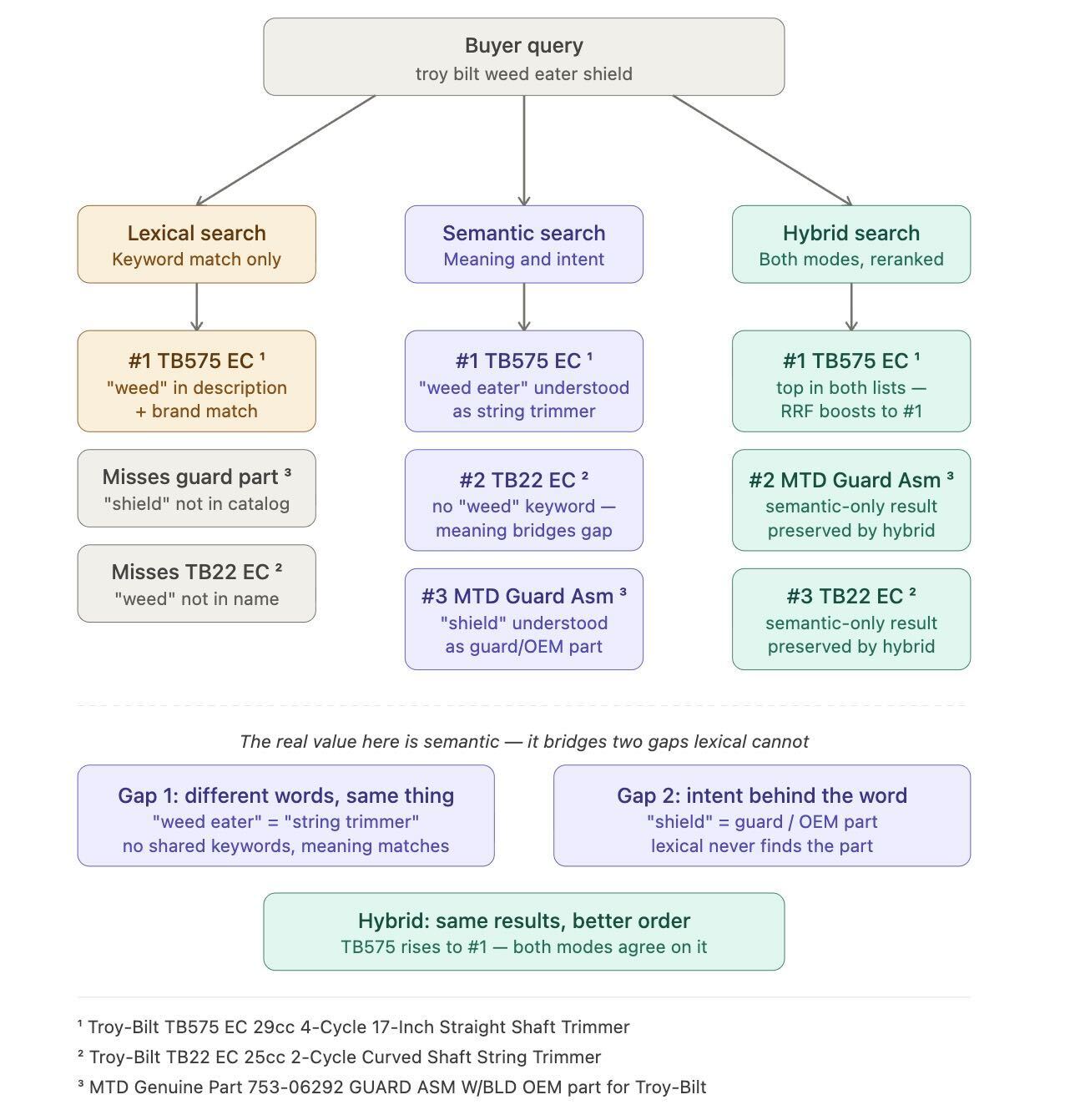
In addition, commercetools’ Storefront Search API delivers the following capabilities out of the box:
For many B2B companies, having search capabilities deeply integrated with the underlying commerce data model offers significant advantages. When search is tightly connected to product catalogs, prices, stores, product selections and entitlements, it becomes significantly easier to ensure that every query — whether from a human user or an AI agent — returns accurate, context-aware results.
This integration becomes especially critical in the era of agentic commerce, where AI systems are not just assisting discovery but actively retrieving, comparing and reasoning over product data on behalf of buyers. In these environments, search becomes a structured interface for machine-driven decision-making.
A platform-native approach ensures that search reflects the commerce data layer directly. That means:
For B2B organizations, this turns search from a standalone integration effort into a built-in capability of the commerce platform — one that’s immediately available and ready to support both traditional and AI-driven discovery experiences.
In B2B commerce, search is a key driver of product discovery, evaluation and conversion. As buying journeys become more digital and increasingly shaped by AI, the ability to connect customer intent with the right product data in real time is critical.
commercetools’ Storefront Search API aligns search directly with the underlying product data model. This enables manufacturers, distributors and wholesalers to deliver fast, relevant and context-aware discovery experiences quickly, without adding unnecessary system complexity.
This becomes especially important in the era of AI-assisted and agentic commerce, where both human buyers and AI agents rely on a structured commerce foundation to search, compare and decide.
For B2B organizations, this translates into clear outcomes:
As product discovery evolves beyond traditional search interfaces, success depends on tightly connecting intent, data and execution. commercetools provides that foundation, helping teams focus less on system integration and more on delivering the exceptional experiences their customers expect.

Start Your 60-Day Free Trial
Start building your commerce innovation for free. Get full access to the commercetools platform to pilot your project.

Alexandra Stolzenberger is a Senior Product Manager at commercetools, specializing in search. With over a decade in eCommerce, she brings deep domain expertise and a sharp product instinct — from defining strategy to shipping solutions that scale. Based in Berlin.

With over a decade of experience across product and marketing teams in the tech world, Julia specializes in creating innovative, customer-first strategies and driving cross-functional growth and go-to-market initiatives.
Receive monthly updates on trends, products and growth insights in your inbox.