
Get in touch
Stay informed
Receive monthly updates on trends, products and growth insights in your inbox.





Businesses are moving beyond traditional automation and analytics toward AI systems that can make decisions, take action, and continuously optimize operations in real time. But what exactly is autonomous commerce, and how does it differ from other emerging AI concepts, such as agentic commerce?
In this short guide, we answer the most important questions about autonomous commerce, including how it works, why agent orchestration matters, what benefits it offers and the foundations businesses need to adopt it successfully.
Autonomous commerce is an operating model in which AI agents execute the day-to-day work of running commerce operations, within the rules and guardrails the business defines.
Unlike traditional automation, which relies on fixed rules, or agentic commerce, which acts on behalf of consumers, autonomous commerce enables AI to run the operations side of the business in real time, at a scale and speed no human team can match.
For example, AI agents can autonomously adjust pricing in real-time based on demand signals, trigger replenishment without a rules-based purchase order workflow or rework promotional campaigns based on results.
The role of humans becomes more strategic, setting the rules instead of focusing on the nitty-gritty, and the system executes within those guardrails.
Autonomous commerce refers to AI running the operational side of a business. Instead of simply providing recommendations or insights, AI systems can continuously manage pricing, inventory, merchandising, promotions, marketing campaigns and other day-to-day operations with minimal human intervention. The goal is to optimize business performance by making decisions and executing actions in real time.
Agentic commerce, by contrast, is the consumer-facing shopping experience. Here, an AI agent acts on behalf of the buyer: Understanding their preferences, researching products, comparing options, making recommendations, and in some cases completing purchases on the customer’s behalf. The focus is on helping consumers shop more efficiently and making the buying experience more personalized.
While both are part of the broader AI commerce landscape, they solve different problems. Autonomous commerce transforms how businesses operate behind the scenes, while agentic commerce transforms how consumers discover, evaluate and purchase products. Together, they represent two complementary sides of the same AI-driven commerce ecosystem.
As AI drives the next wave of enterprise technology, the rise of autonomous commerce almost seems like the obvious next step. After all, businesses are continuously evolving toward autonomy across various parts of the business, from self-running systems to auto-adapting products.
For instance, Gartner predicts that “autonomous business is coming, powered by AI,” with autonomous operations playing a key role in enhancing efficiency and productivity across the board. This includes AI agents that monitor performance around the clock and make split-second decisions based on real-time data.
GartnerⓇ Hype CycleTM for Digital Commerce, 2026, reinforces this message, stating that “AI agents for commerce operations are expected to have a transformational impact in the next two to five years, due to their quickly becoming a common capability in commerce solutions. Typical use cases include merchandising configurations, setup of rules and campaigns, event-based actions, and insight analytics. The primary benefit is productivity enhancement.”
Autonomous commerce will impact the workforce in many ways, starting with machines taking over the grunt work while humans tackle bigger challenges that require creativity and ingenuity. By 2028, Gartner predicts that 40% of services will be AI-augmented, enabling employees to focus on higher-value work as technology transforms every role.
The rise of AI agents will also change how employees use technology. Today, users navigate multiple digital interfaces and input commands to get results. Often, they need to patch together results from multiple tools to get a 360-degree view of the business, delaying decisions that should have been made in real time.
This dynamic will change as business users adopt AI agents for daily tasks by using natural language, which is already used and understood in consumer applications, effectively lowering the barrier to AI adoption for internal workflows.
Autonomous commerce helps businesses operate with greater speed, efficiency and agility by shifting routine decision-making and execution from people to AI. Instead of relying on manual processes and periodic analysis, AI continuously monitors changing conditions, makes real-time decisions, and takes action across the business.
Key benefits include:
By automating operational decisions while keeping humans focused on strategy and oversight, autonomous commerce enables organizations to scale more effectively and adapt continuously to changing business conditions.
Autonomous commerce reduces operational costs by automating the continuous decision-making and coordination required to run modern commerce operations. Instead of relying on teams to manually analyze data, manage exceptions and execute changes across disconnected systems, AI agents continuously monitor business conditions, make recommendations and take action within defined guardrails.
The largest cost savings come from eliminating manual operational work, reducing process complexity and improving the accuracy of business decisions. AI agents can automate tasks such as pricing optimization, inventory management, campaign execution, product merchandising and order operations, allowing teams to manage more scale without adding proportional headcount. At the same time, real-time intelligence helps reduce costly inefficiencies such as overstock, stockouts, pricing errors and underperforming campaigns.
Autonomous commerce also lowers the cost of coordination. Through agent orchestration, specialized AI agents can work together across functions, reducing the time spent on handoffs, approvals, and manual workflows. The result is a more efficient operating model in which teams focus on strategy and oversight while AI handles repetitive, high-volume decisions.
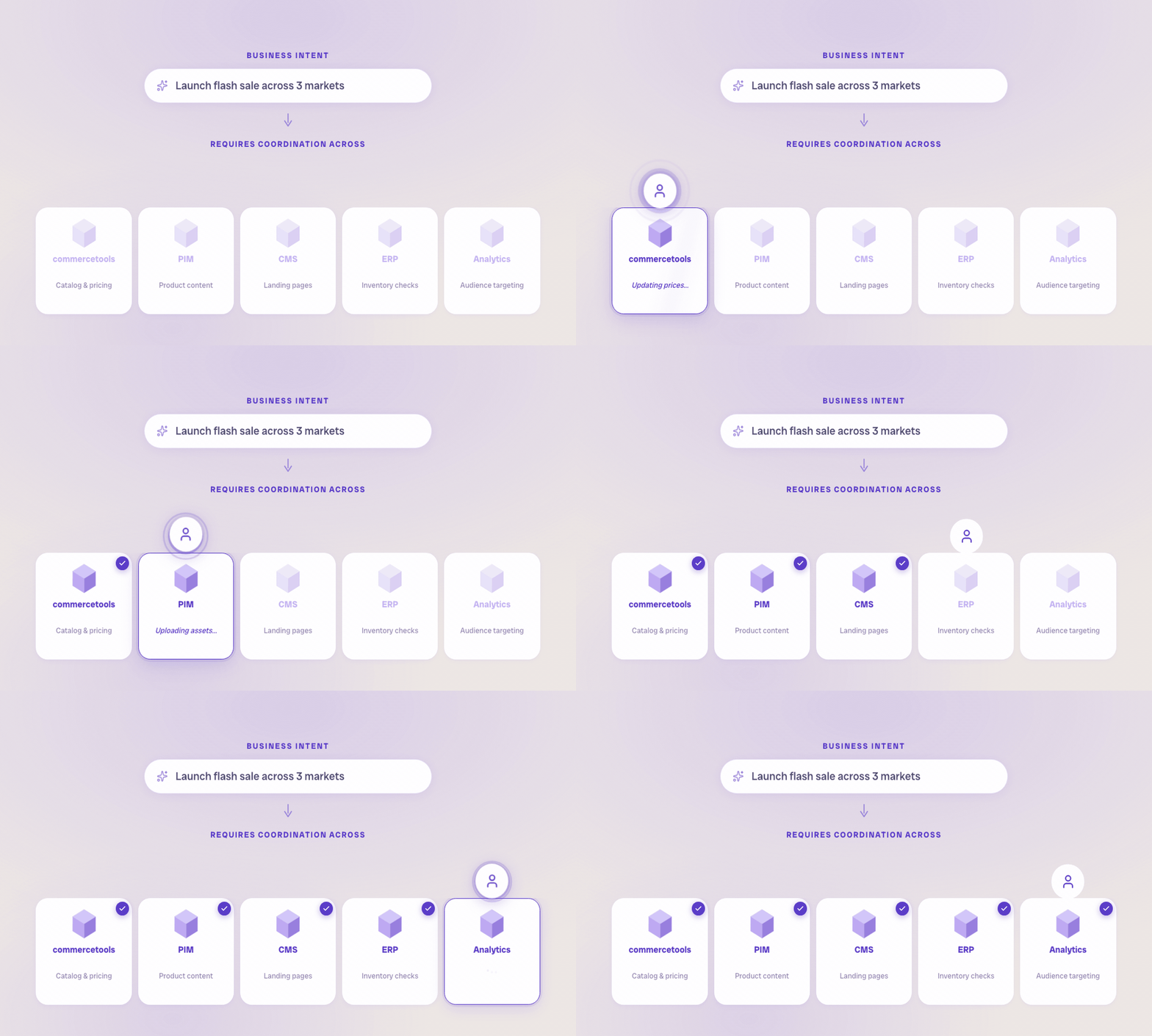
Agent orchestration is the coordination layer that makes autonomous commerce possible at scale. While individual AI agents can perform specific tasks, such as optimizing prices, forecasting inventory, managing promotions or responding to customer requests, those tasks don’t happen in isolation. Decisions made in one area often have consequences across the rest of the business.
Agent orchestration ensures specialized agents work together toward shared business goals:
Instead of dozens of independent automations, orchestration creates a unified system that can make coordinated decisions across merchandising, marketing, operations, supply chain and customer experience.
Without orchestration, autonomous commerce is simply a collection of AI-powered tools. With orchestration, it becomes an intelligent operating model that continuously optimizes the business as a whole.
Autonomous commerce requires more than AI as it depends on a modern commerce architecture that enables AI agents to make decisions, take action and operate safely at enterprise scale. Three foundational capabilities are essential:
Every core commerce capability, from products and pricing to inventory and checkout, must be exposed through real-time APIs.
This gives AI agents the ability to interact with commerce systems just as applications and developers do today, while an open, composable architecture allows businesses to integrate any channel, agent or AI model without custom builds. A cloud-native platform provides the scalability needed to support machine-speed, machine-volume commerce.
Individual AI agents can optimize specific functions, but autonomous commerce requires them to work together. Agent orchestration coordinates specialized agents across pricing, promotions, merchandising, inventory and fulfillment, ensuring decisions are aligned with shared business goals.
Business users define outcomes and policies, while the platform manages execution across agents and systems. A model-agnostic approach also allows organizations to adopt new AI models without vendor lock-in.
Enterprise autonomy requires trust. Every AI agent should have a defined identity, permissions and access boundaries, with human approval built into high-impact decisions.
Enterprise-grade security, compliance, auditability and governance ensure organizations can deploy autonomous commerce confidently while maintaining control over how AI operates.
Autonomous commerce represents the next evolution beyond traditional automation, enabling businesses to move from manual decision-making to AI-driven operations that continuously analyze, optimize and act in real time. But achieving true autonomy requires more than individual AI agents; it requires a foundation of orchestration, connectivity and governance to ensure AI works effectively across the enterprise.
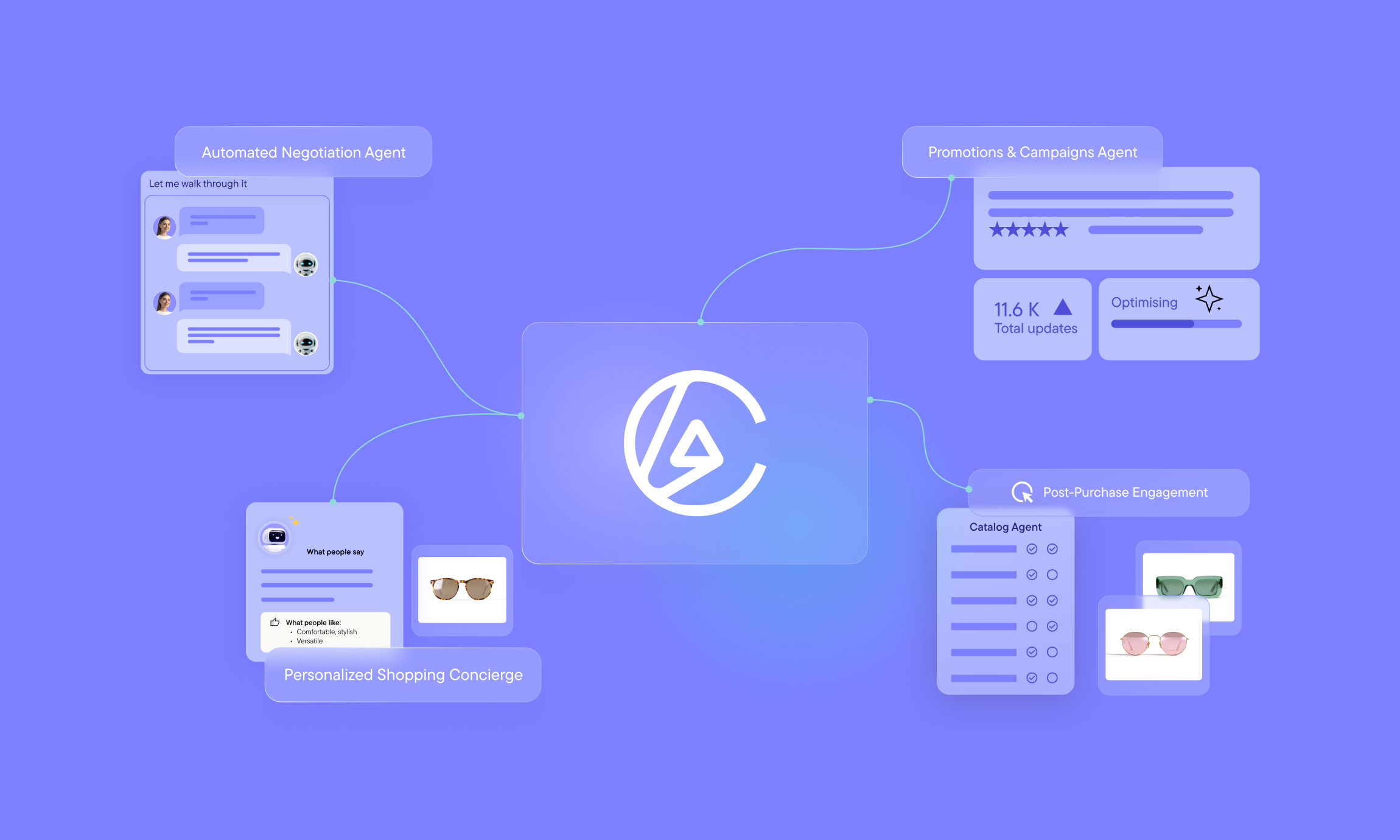
MosAIc is commercetools’ orchestration layer that enables this future, spanning the full technology stack to coordinate first- and third-party agents against real commerce data. By dynamically composing the right experience around the business goal, MosAIc helps organizations turn a collection of AI capabilities into a unified, intelligent operating model.
Be among the first to run on MosAIc: Join the waitlist and get notified when it’s ready for your team.

Manuela leads content strategy at commercetools. With over 20 years of experience in B2B SaaS, she writes about all things commerce by day and turns to fiction by night. She loves long walks, traveling, and, unsurprisingly, reading books.
Receive monthly updates on trends, products and growth insights in your inbox.