Get in touch
Stay informed
Receive monthly updates on trends, products and growth insights in your inbox.





We’re entering a new era of autonomous commerce, in which AI doesn’t just support commerce operations, it actively runs and optimizes them in real time. This shift is fundamentally redefining how customers discover, evaluate and purchase, and how businesses operate behind the scenes.
Autonomous commerce promises fully adaptive, self-optimizing experiences for customers and significant gains in efficiency, automation and value creation for businesses. But this transformation depends on the foundation capable of powering systems that can reason, decide and act continuously across channels, contexts and customer signals.
For organizations aiming to lead in this new era, the priority is clear: Make enterprise infrastructure AI-ready and capable of supporting autonomous decision-making at scale. For many, this means accelerating the modernization journey already underway.
Traditionally, enterprise infrastructure refers to the underlying combination of hardware, software and network systems that ensure reliability, uptime and efficient operations. It was designed to support structured, predictable workflows that are largely defined and managed by humans.
But this definition is changing rapidly as enterprise infrastructure evolves from a technical foundation that keeps a business running to a strategic layer that directly influences how fast a company can innovate, scale and compete.
In a nutshell, enterprise infrastructure is increasingly tied to business agility rather than just operational stability.
In traditional enterprise thinking, infrastructure is primarily the technical foundation that supports applications: Compute, storage, networking, databases and the systems that ensure uptime and reliability. It’s typically managed as a cost center, with priorities centered on stability, standardization and controlled, incremental change.
In modern commerce, especially in a modular and AI-driven context, enterprise infrastructure takes on a broader role. It becomes the end-to-end architecture that powers customer experiences and business execution across every channel. This includes the commerce engine itself, as well as the orchestration layer connecting core enterprise systems such as ERP, CRM, OMS, payments and service platforms.
With AI and increasingly agentic and autonomous capabilities, this distinction becomes even more pronounced. Modern commerce infrastructure must be AI-native by design, capable of supporting systems that o recommend, orchestrate, and, in some cases, autonomously trigger commerce actions based on real-time signals.
The following five building blocks provide an overview of how infrastructure is evolving from a passive foundation to an active enabler of autonomous commerce.
For autonomous commerce to work at scale, organizations need five foundational capabilities.
The first requirement is making commerce capabilities natively accessible to AI. Products, pricing, inventory, promotions, carts, orders and customer data must be available through structured, machine-readable interfaces that agents can discover and interact with. Without this layer, AI remains disconnected from the systems where commerce actually happens.
Agent-ready infrastructure transforms commerce systems from applications designed exclusively for humans into platforms that can support both human and AI interactions.
As AI agents gain the ability to make recommendations, trigger workflows and execute actions, organizations need clear governance around what agents can access, what decisions they can make and how their activities are monitored.
Security, permissions, compliance controls, auditability and observability become critical foundations for building trust in autonomous systems.
AI creates value when it can interact with the broader business ecosystem.
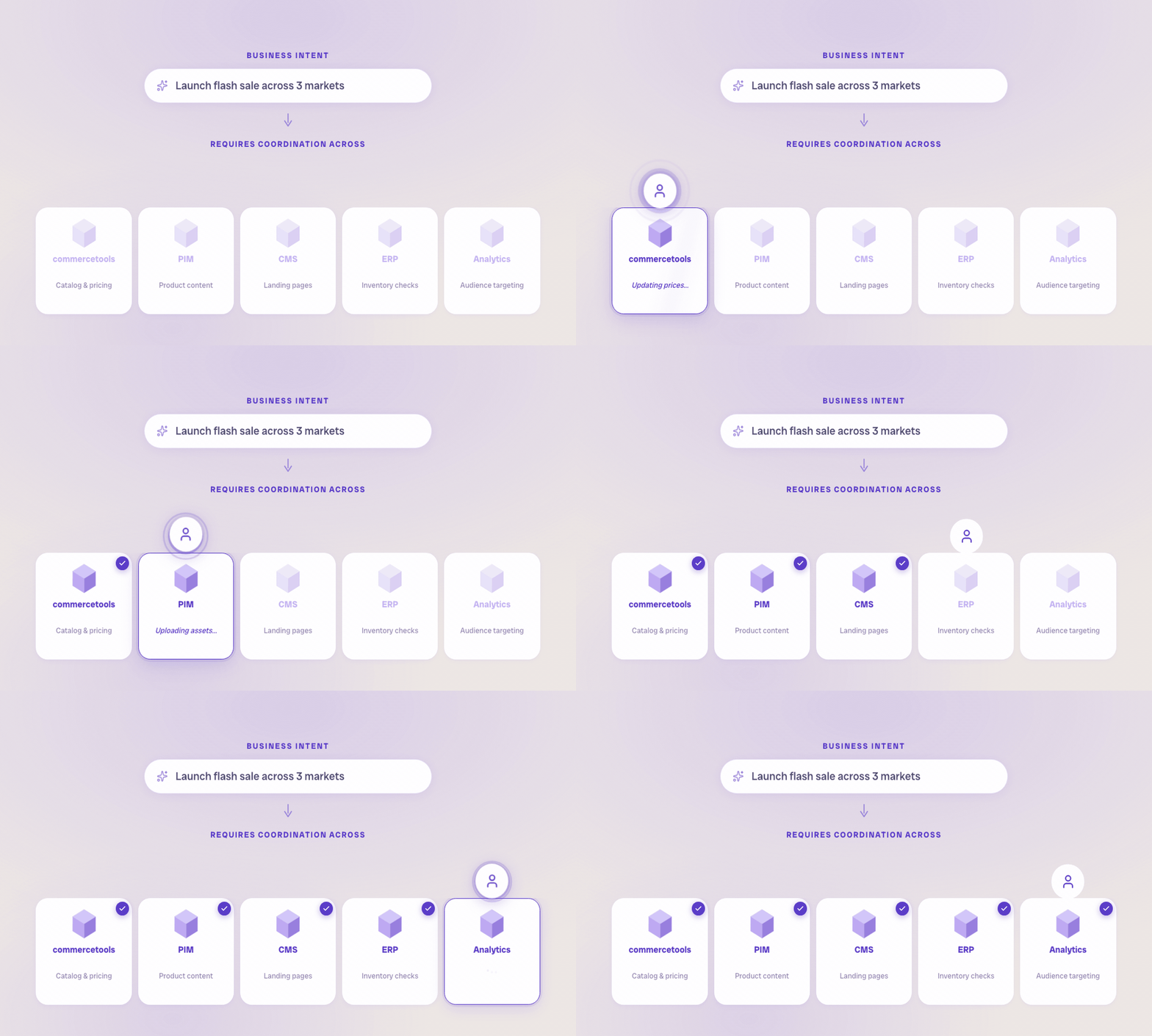
Autonomous commerce requires infrastructure that can connect data, workflows, events and enterprise systems in real time. This means integrating seamlessly with ERP, CRM, OMS, fulfillment, customer service and other operational systems.
A flexible orchestration layer allows businesses to introduce new capabilities, connect new services and evolve AI-driven workflows without disrupting core operations.
In addition, an extensible platform makes it much easier to add modules, plugins, integrations or custom components, enhancing the system’s functionality without compromising stability or backward compatibility.
As agents become active participants in commerce, organizations need visibility into how they operate.
Teams should be able to understand what actions agents are taking, why decisions are being made, and how those decisions impact business outcomes. Comprehensive logging, monitoring and auditability help ensure autonomous systems remain transparent and measurable.
Autonomous commerce is always on, and the infrastructure supporting it must be capable of handling fluctuating demand, scaling globally, recovering from failures and maintaining consistent performance across channels and markets.
Cloud-native architectures, high availability, auto-scaling, disaster recovery and self-healing capabilities ensure that autonomous systems remain reliable even under peak loads and rapidly changing conditions.
Most commerce organizations are already on a modernization journey. The challenge is how to modernize in a way that supports AI, autonomous commerce and future business models without introducing unnecessary risk.
The good news is that becoming AI-ready doesn’t require a costly rip-and-replace transformation. Here are five practical recommendations for enterprises modernizing their commerce infrastructure.
Most enterprises have significant investments in ERP, CRM, OMS, PIM, and other core platforms that continue to provide value. The goal is to modernize around these systems, not necessarily replace them.
A modular architecture allows organizations to introduce new capabilities incrementally, modernize high-impact areas first, and reduce both technical and business risk. Teams can evolve their architecture over time while continuing to deliver value to customers and the business.
This approach also creates flexibility for adopting emerging AI technologies without becoming locked into a single vendor or technology stack.
Customer expectations, market conditions and AI capabilities will continue to evolve. Infrastructure needs to support continuous experimentation, iteration and improvement rather than periodic transformation projects.
Modern architectures allow businesses to scale individual capabilities independently, introduce new services quickly and adapt customer experiences without disrupting the broader ecosystem. Organizations that build for adaptability today will be better positioned to take advantage of tomorrow’s innovations.
Before investing in new technologies, organizations should understand where they are today. Key questions include:
The answers help identify the highest-impact areas for modernization and reveal potential barriers.
Infrastructure modernization is ultimately about enabling people as much as it is about technology.
As AI accelerates the pace of innovation, business and technical teams need the ability to prototype, test, learn and launch new experiences quickly. The organizations that move fastest will be those that reduce complexity and lower the barriers to experimentation.
Enterprises can significantly reduce implementation time, engineering effort and operational costs by embedding AI into the way they design, configure and extend commerce systems.
This shifts implementation from manual, code-heavy delivery toward AI-assisted system design, enabling faster time-to-value and more iterative, adaptive development cycles.
With commercetools, organizations across manufacturing, B2B distribution, retail and omnichannel commerce are accelerating time-to-market, improving operational efficiency and scaling across markets without adding complexity.
These examples show how modern commerce translates into measurable business outcomes in real-world enterprise environments.
For B2B manufacturers, digital transformation often entails managing complex pricing structures, dealer networks and fragmented legacy systems that impede innovation.
A leading global paint manufacturer modernized its commerce infrastructure with commercetools to support a highly complex dealer-based business model spanning thousands of stores. By moving away from a rigid monolithic system, the company gained the flexibility to manage localized pricing, streamline promotions and deliver seamless experiences across every channel.
The result was a significant improvement in operational efficiency, including faster price updates, improved system performance and a major boost in deployment speed, enabling teams to deliver changes in hours and days instead of weeks or months.
Another example is Coflex, a global manufacturer of plumbing solutions. The company launched a fully functional B2B commerce platform in just 90 days with commercetools. This rapid implementation enabled faster digital revenue generation and significantly improved the company’s ability to serve its B2B customers through a modern self-service experience.
Modern commerce infrastructure must support growth across channels, geographies and seasonal peaks without compromising performance or customer experience.
L.L.Bean, an outdoor apparel retailer, modernized its digital commerce foundation with commercetools to support omnichannel experiences and evolving customer expectations. By moving away from legacy constraints, the company gained the flexibility to evolve its digital experience more rapidly while maintaining the reliability required for large-scale seasonal demand.
Similarly, ARK Bokhandel, Norway’s leading bookstore chain, used commercetools to strengthen its digital commerce capabilities and support a more scalable infrastructure. This enabled the business to better align its physical retail footprint with its growing online operations, while improving responsiveness to market and customer needs.
Flügger, a leading paint manufacturer, modernized its commerce architecture using commercetools to replace tightly coupled legacy systems and fragmented integrations. By adopting a composable approach, the company was able to reuse commerce capabilities across multiple channels, integrate PIM systems more effectively and reduce operational friction across markets.
This enabled Flügger to unify digital and physical commerce operations while increasing flexibility in how systems and services are connected across the enterprise.
Pet Valu, a leading retailer of pet supplies, modernized its digital commerce platform with commercetools to support rapid innovation across its store and online network. The company improved site performance, accelerated feature delivery and enabled more seamless omnichannel experiences across its ecosystem of stores and digital touchpoints.
This transformation has allowed Pet Valu to scale its digital capabilities while continuously improving customer experience and operational efficiency across channels.
Across manufacturing, B2B distribution and global retail, enterprises are increasingly modernizing their enterprise infrastructure to reduce complexity, accelerate time-to-market, enable agentic shopping and prepare for autonomous commerce.
The transition to autonomous commerce won’t happen overnight; it’s an incremental evolution toward infrastructure that’s more flexible, more connected and more capable of responding to real-time signals across the business and customer journey.
Organizations that succeed in this shift will be those that modernize step by step, design for continuous change rather than one-off transformation, take a realistic view of their readiness and empower teams to experiment and innovate safely.
Talk to an expert and discover how Sphere, our enterprise commerce platform, enables the autonomous era.
Autonomous commerce is an AI-driven model in which systems can reason, decide, and execute commerce operations in real time across channels.
Legacy systems are built for predefined workflows and struggle to support real-time, AI-driven actions at scale without breaking or limiting flexibility.
AI-ready infrastructure provides structured data, APIs, governance and real-time access, enabling AI agents to safely interact with commerce systems.
Yes. Incremental modernization allows businesses to reduce risk while progressively building AI-native, modern capabilities that serve as the foundation for autonomous commerce.
Key capabilities include agent readiness, governance, extensibility, observability and resilience at a global scale.

Manuela leads content strategy at commercetools. With over 20 years of experience in B2B SaaS, she writes about all things commerce by day and turns to fiction by night. She loves long walks, traveling, and, unsurprisingly, reading books.
Receive monthly updates on trends, products and growth insights in your inbox.