


Get in touch
Stay informed
Receive monthly updates on trends, products and growth insights in your inbox.




Online commerce for B2B manufacturers has reached an inflection point: Nearly two-thirds of B2B industrial buyers now regularly purchase industrial supplies online. Manufacturers who have fought hard for years to build eCommerce platforms haven’t reached the finish line, though. In fact, most are realizing that the finish line has moved.
The eCommerce environment that B2B manufacturers designed five years ago no longer exists. Changing consumer preferences, omnichannel sales and the rise of AI mean that B2B sellers need to rethink how they build and manage their eCommerce solutions.
In years past, B2B manufacturers faced a build vs. buy or bespoke vs. off-the-shelf choice. They could buy a SaaS eCommerce solution or build their own. Most off-the-shelf platforms weren’t designed to meet B2B needs, such as:
For those reasons, most B2B manufacturers and industrial sellers chose to build their own platform. Today, those homegrown eCommerce platforms have turned into overly rigid systems drowning in technical debt.
B2B manufacturers that operate on homegrown commerce platforms face frequent performance issues, fragmentation, slow adaptability and enormous technical debt.
Many in-house eCommerce platforms are built around forecasted demand rather than elastic scalability. As order volumes, customer activity, product catalogs or integrations grow, performance can degrade, leading to slow response times, system instability or downtime during critical business periods.
To avoid these issues, organizations often over-provision infrastructure to accommodate potential growth, resulting in unnecessary costs and underutilized resources. The result is a platform that’s either unable to scale efficiently when needed or expensive to maintain when demand is lower.
The capacity problem only worsens for global expansion: A homegrown system built for one region must be manually extended for each new market, including separate deployments, data residency configurations and localization logic.
Each expansion multiplies the operational burden and imposes significant time and engineering costs on businesses.
Today’s B2B manufacturers must support a mix of digital self-service and salesperson-assisted buying experiences. Customers increasingly expect to research products, configure orders, access account-specific pricing and place orders online, while still engaging sales representatives for complex purchases, negotiations and ongoing account management.
Many homegrown commerce platforms were originally built around a single web channel and later extended to support evolving sales processes. At the same time, they must integrate with critical systems such as ERP, CRM, PIM, pricing, and inventory platforms. The result is often a patchwork of point-to-point integrations, custom middleware and synchronization processes that are difficult to maintain. As complexity grows, system updates and business changes become increasingly costly and risky.
Every homegrown system is a proprietary system. The engineers or developers who built it hold structural knowledge that can’t be easily transferred, documented or replicated. When those people leave, the organization inherits a maintenance burden: A system without an owner’s manual.
Meanwhile, the total cost of ownership continues to escalate: Hosting, security patching, custom integration maintenance and the compounding interest of technical debt.
While mass-market eCommerce platforms have entire product and development teams dedicated to shipping new features, manufacturers managing homegrown solutions are stuck in reactive mode. These engineering teams spend far more time maintaining their current architecture than building new features: A single update to a checkout can take months. Their architecture means that new features are developed in isolation, carefully integrated with tightly coupled modules, tested end-to-end and deployed through a single pipeline.
Shifting customer expectations is now the norm, and sellers operating on custom solutions will always be a step behind the latest advancement.
While homegrown commerce platforms were the right decision for B2B manufacturers 10 years ago, they aren’t the right choice for the future of commerce. These legacy monolithic systems are preventing sellers from adopting personalization, omnichannel selling, agentic commerce and whatever comes next. Costly downtime and technical debt are eating into profits.
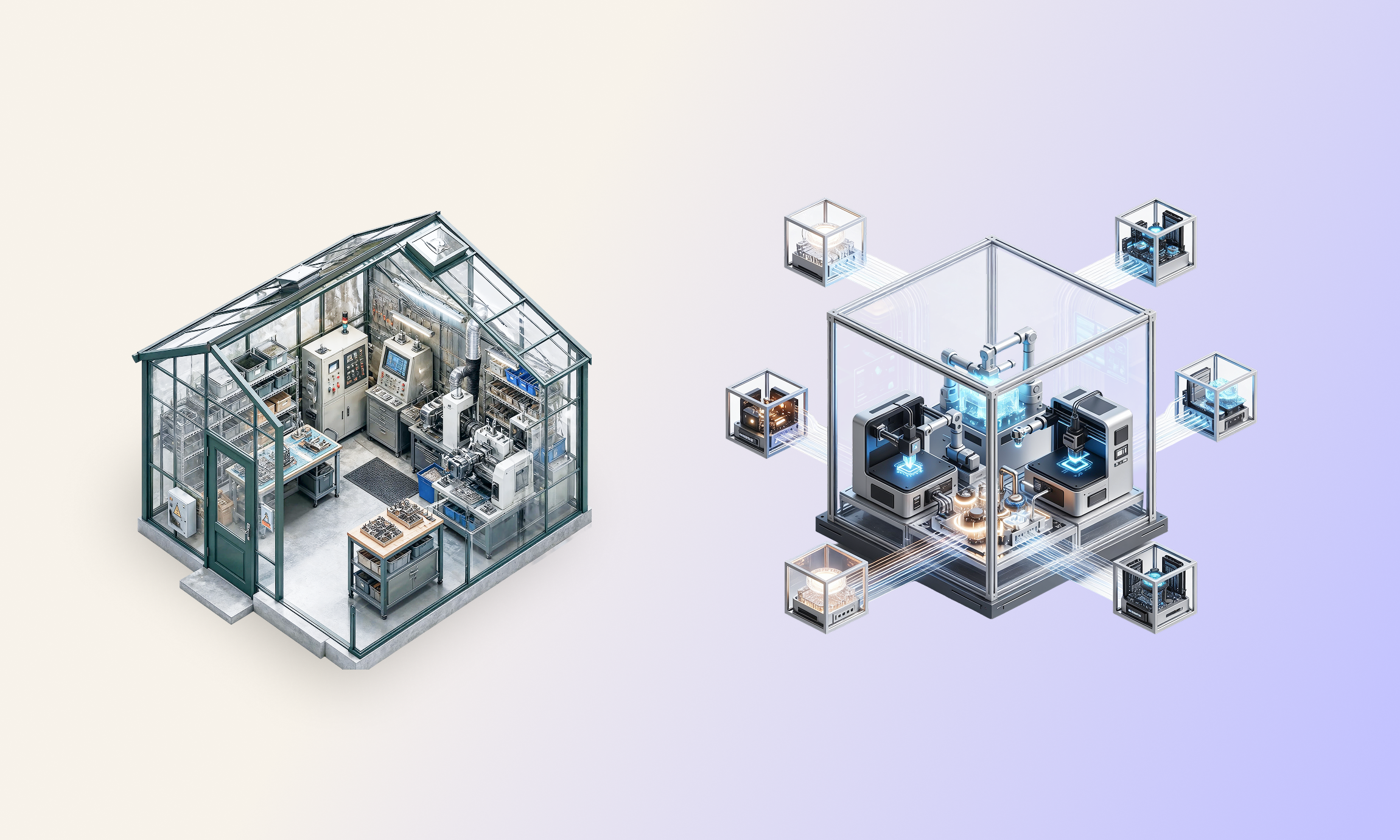
Modern commerce is no longer monolithic. It needs to be adaptable and agile so it can add or change layers of functionality without rebuilding the entire platform.
Instead of choosing between building from scratch and a rigid B2C solution, companies can use a buy-and-build approach.
Manufacturers and industrial suppliers have unique requirements. While customers now expect consumer-grade functionality, such as building a cart and checking out without speaking to a salesperson, the backend reality is complex. Here are the practical capabilities that you need for successful eCommerce.
With all these needs, it’s tempting to think that your requirements are too complex for any platform. Many businesses feel stuck in their current systems, believing that the available platforms are too rigid, the sunk cost is too high and the migration risk is too real.
Those same businesses that stick with homegrown solutions for too long risk losing customers and revenue due to site performance issues and outdated features.
Here are three examples of B2B manufacturers, distributors and wholesalers who successfully launched a flexible eCommerce website to replace their homegrown solution with commercetools.
When the pandemic disrupted its traditional in-person sales model, Chilean distributor Adelco needed to digitize quickly, but its initial homegrown apps were rigid, lacked real-time inventory visibility and required manual data entry.
Adelco adopted commercetools for its combination of flexibility and adaptability. It built an omnichannel strategy that seamlessly connected its eCommerce site, customer app and sales representative apps.
This modern approach eliminated manual workflows, provided real-time stock visibility, and empowered sales reps to act as business consultants rather than simply order-takers. The result was a 400% increase in eCommerce sales, a 25% boost in SKUs per order for self-service customers and a 20% higher conversion rate.
Interior landscaping B2B company Nieuwkoop Europe found that its homegrown eCommerce site served only customers who knew exactly what they wanted, lacking the intuitive product discovery needed to attract new clients. To future-proof its digital presence, the company migrated to commercetools and launched a revamped B2B shop available in 4 languages across 40 countries.
The new platform allows Nieuwkoop to segment product catalogs by target audience and region, while inspiring customers with cross-selling ideas like matching pots and complete plant displays. This customer-centric transformation drove a nearly 100% increase in eCommerce revenue over three years and significantly reduced routine calls to internal sales staff.
New Zealand business supplies provider NXP had a custom-built portal tailored for enterprise clients, but it was too manual and slow to support a new strategic push into the midmarket, which demanded a consumer-grade, self-service experience. Thanks to commercetools, NXP built a new midmarket platform that streamlined previously manual processes like account creation, returns and marketing messages.
This shift reduced account setup time from weeks to just 20 seconds, dropped customer service inquiries by 92% through a new self-service portal, and halved marketing campaign turnaround times. After this transformation, NXP is on track to triple its midmarket revenue over the next five years.
The reality for B2B manufacturers is that homegrown commerce platforms — originally built for the ultimate control — have become their primary obstacles to growth. Custom-built commerce platforms buckle under peak traffic, fracture across new touchpoints and trap teams in endless maintenance cycles.
The decision is no longer SaaS vs. custom eCommerce for B2B manufacturers, distributors or wholesalers. Instead, businesses can build and buy to reach the performance level and exact customization they need.
commercetools provides a modern, flexible foundation designed to solve these pain points. By replacing rigid, homegrown systems with an API-first architecture that enables customization and extensibility, B2B sellers can scale efficiently and adapt to future changes.
Modern B2B manufacturers are operating in an environment defined by complexity: Hybrid sales models, customer-specific pricing, ERP-driven processes and globally distributed operations. In this context, legacy homegrown platforms often struggle to keep up, constrained by rigid architectures and escalating technical debt.
commercetools provides a modern foundation that handles this complexity without locking businesses in. Its high-performance, elastic infrastructure scales automatically with demand, supporting large B2B transaction volumes while maintaining reliable performance and uptime. This eliminates the need for costly overprovisioning or constant infrastructure tuning, providing manufacturers with a stable foundation for global operations and mission-critical commerce flows.
Beyond performance, commercetools unifies the increasingly fragmented B2B landscape. It connects real-time product, pricing and inventory data across systems like ERP, CRM and PIM, enabling consistent experiences across digital self-service and sales-assisted channels. With support for emerging AI-driven commerce use cases, manufacturers can also make their product data accessible to new purchasing interfaces without re-architecting their systems.
At its core, the commercetools platform is modular by design. Businesses can adapt and extend functionality incrementally, rather than rebuilding monolithic systems with every change in strategy or market requirement. This flexibility allows manufacturers to reduce technical debt, accelerate innovation and evolve their commerce capabilities in step with changing customer expectations and global expansion needs.

White Paper
B2B Commerce Buying Guide
Get the guide to help you evaluate requirements and capabilities for modern B2B commerce platforms.

Manuela leads content strategy at commercetools. With over 20 years of experience in B2B SaaS, she writes about all things commerce by day and turns to fiction by night. She loves long walks, traveling, and, unsurprisingly, reading books.
Receive monthly updates on trends, products and growth insights in your inbox.