

Get in touch
Stay informed
Receive monthly updates on trends, products and growth insights in your inbox.




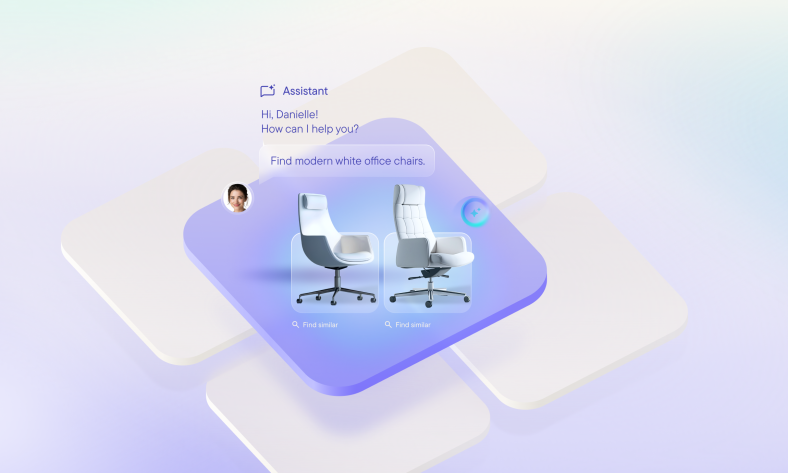
Has AI already become mainstream in consumer journeys? The answer is a resounding yes:
Enterprises got the memo — and many have already started leveraging AI, so much so that Gartner predicts that 60% of brands will use agentic commerce for autonomous customer interactions by 2028.
However, the flurry of new protocols (ACP, UCP, MCP, you name it), OpenAI’s recent setback with Instant Checkout, and the rapid pace of market development create significant uncertainty. So, while retail leaders know there’s an immense opportunity in agentic commerce, they’re often at a loss for how to start — and how to manage this unpredictability.
For retailers attempting a DIY approach, the challenge is even greater. Building and maintaining integrations for each AI channel can delay market entry and increase risk. A single-channel bet may backfire if that channel slows down or consumer preferences shift — wasting time, money and effort.
This is exactly why commercetools built the AI Hub: A solution that manages volatility, simplifies experimentation and enables brands to tap into agentic commerce efficiently and safely.
commercetools AI Hub acts as a universal orchestration layer, translating your brand’s commerce logic seamlessly across AI channels like Gemini, Copilot and ChatGPT. This allows brands and retailers to become both discoverable and shoppable wherever customers engage, adapt quickly to an evolving market landscape, and ultimately turn AI-driven conversations into measurable revenue.
As AI-driven shopping evolves beyond simple product discovery, it becomes essential for brands and retailers to maintain accurate, machine-readable product catalogs, pricing and inventory across all AI channels. This foundation enables truly end-to-end AI shopping experiences — from dynamic bundling and personalized offers to seamless orchestration of checkout, pricing, inventory and orders — all natively within the AI interface.
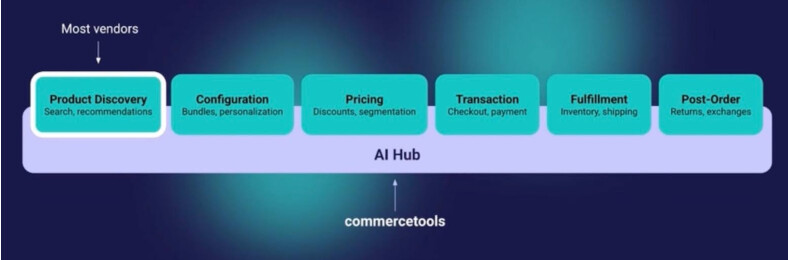
Moreover, businesses can activate the AI channels that make the most sense for them using AI Hub’s pre-built, easily configurable modules. This approach provides maximum flexibility, enabling brands to experiment, adapt quickly and accelerate time-to-market.
At its core, AI Hub translates your products within a commercetools project into formats that are immediately compatible with any AI channel. Key benefits include:
Additionally, the commercetools team works closely with major AI providers at both the product and strategy level, ensuring that AI Hub stays aligned with the latest developments and future roadmap of each platform.
Some companies consider integrating AI channels directly, but a DIY approach requires building custom commerce endpoints for each platform and channel — a costly and time-consuming approach.
AI Hub mitigates these risks by enabling multi-channel activation through a single, unified integration that orchestrates agentic commerce across all channels securely, consistently and effortlessly.
Retailers like Frasers Group, JD Sports, Liverpool and John Lewis Partners are already leveraging AI Hub to accelerate their agentic commerce adoption:
Retailers like Frasers Group, JD Sports, Liverpool and John Lewis Partners are already leveraging AI Hub to accelerate their agentic commerce adoption:
A global leader in sports fashion retail, JD Sports is actively preparing for AI-powered shopping by enabling customers to search for and purchase footwear, apparel and accessories directly through AI platforms such as Microsoft Copilot, Google Gemini and OpenAI’s ChatGPT.
JD’s omnichannel strategy combines immersive, theatrical stores with cutting-edge digital platforms, including a re-platformed eCommerce system via commercetools. Integrating AI with Stripe’s Agentic Commerce Suite (ACS) further enhances the customer journey by providing real-time stock updates, personalized recommendations, and secure, frictionless checkout.
Frasers Group will become one of the first European retailers to enable shoppers to discover and purchase products across its retail ecosystem (Sports Direct, FLANNELS and FRASERS) within AI shopping channels.
Mexico’s largest department store, Liverpool, will be able to safely test, measure and scale AI-enabled journeys across its digital channels and store network without changing its core commerce stack — all enabled by commercetools.
With the ambition to be one of the first UK retailers to fully adopt and integrate the technology, John Lewis will enable shoppers to find inspiration on AI platforms such as Google Gemini and ChatGPT, and to transact and purchase items via these apps within a few clicks. The capabilities are expected to be available in 2026.
AI-driven commerce is no longer the future — it’s here. The real challenge is navigating an unpredictable, fast-evolving ecosystem without overcommitting too soon.
commercetools AI Hub removes this complexity. By abstracting fragmentation, enabling multi-channel flexibility, and allowing experimentation without risk, it gives brands the tools to move quickly, follow the data, and turn AI-driven interactions into revenue. The result: a scalable, future-ready path into the next era of retail.

White Paper
Navigating the Agentic Era On Yours terms
The practical guide to help you approach agentic commerce strategically - not out of FOMO

Dolapo is a Product Manager at commercetools focused on Agentic commerce. With over 9 years of experience across retail, FinTech, and eCommerce, he loves to tinker with product data and understand consumer psychology while at it. Away from work, he fancies a good game of tennis.
Receive monthly updates on trends, products and growth insights in your inbox.