


Get in touch
Stay informed
Receive monthly updates on trends, products and growth insights in your inbox.



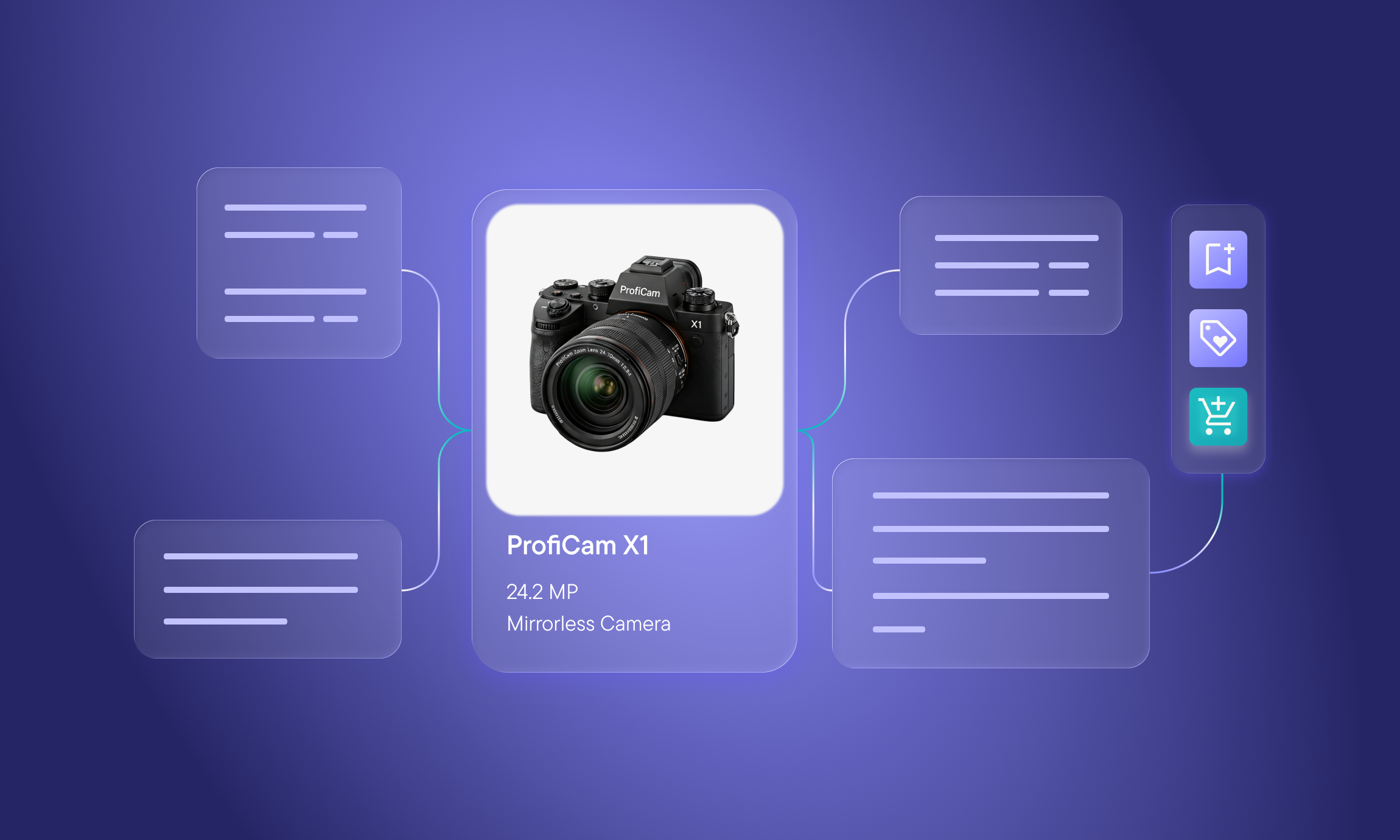

As consumers turn to ChatGPT, Gemini and Copilot to discover products and buy online, many merchants are experiencing a decline in their brand visibility and discoverability. In this new world of zero-click commerce, brands and retailers that haven’t yet structured their product data for AI channels are feeling the pinch of fewer clicks — and fewer conversions.
Gartner research estimates that by 2030, 20% of online shopping transactions will flow through AI platforms and agents. The brands showing up in those results aren’t necessarily the biggest or the best. They’re the ones with structured, machine-readable data. Many eCommerce companies want to be visible and shoppable in AI shopping, but they can’t achieve this without first optimizing their data for LLMs.
In this article, learn what AI-ready data looks like and how to audit and prepare your product data for LLM discoverability.
While agentic commerce still represents a small percentage of shoppers, the potential is massive. ChatGPT receives over 2.5 billion prompts per day, and 2.1% of those are related to purchasable products.
According to Search Engine Land, LLMs are growing quickly as a referral source: Comparing the first half of 2025 with the second half, LLM referral traffic increased by 80%.
AI agents browse differently than humans do. While people may fill in product gaps with impressions from photos, social media searches or brand affinity, AI agents look for clear, structured information and lack external context. So, if your brand has the best product at the best price but the product data is incomplete or hard to read, LLMs likely won’t surface your product, let alone recommend it during a shopping journey.
In addition to meeting the data needs of machines, consumers also require some data to decide whether to buy. According to Syndigo, 44% of online shoppers have abandoned a purchase due to insufficient product data.
Getting your data ready for AI agents requires a multi-layered approach. Think of it as a stack, where each layer builds on the one below it. Gaps at any level create problems at every level above it.
The four layers of AI-ready product data are master data, dynamic data, outcome-focused data and organizational data. Together, these four layers make up agentic-ready data.
Master product data is the core information for your product. This is SKUs, dimensions, weight, materials, country of origin, color and compliance certifications. It’s the information that makes each product unique and easy to compare. Think of master data as the first gate: This is the first query point for AI agents.
In platforms like commercetools, product data is organized by product type and product variants, which link related products in a parent structure. Product data includes attributes, categories and metadata such as title, description and keywords.
When eCommerce sites don’t maintain good data hygiene for products, they run into issues such as inconsistencies and duplications. For example, if online stores dump all product information into the description or a PDF rather than tagging it correctly, machines can’t read it.
Next comes the information that changes regularly: Pricing, stock availability, promotions, lead times, return rates and marketing descriptions. This is the critical piece that separates AI discovery from AI transactions and revenue. You can’t enable AI checkouts without this layer.
Most retailers already know the pain of a successful social media ad where a customer tries to buy a product, only to find it out of stock. According to Gartner, some AI platforms already require a live check of pricing and inventory right before checkout. That’s why accurate, updated dynamic data is essential for AI shopping.
Traditional product data describes features and specifications — the master data we already covered. Outcome-focused data explains what a product does, who it’s for and what problem it solves. In other words, it includes contextual information that matches conversational searches that many shoppers rely on today.
For example, a person might ask, “What’s the best sustainable jacket for hiking in the rain?” The master data may share fabric type and weight, but an outcome-focused description might explain that it’s built for hiking in wet weather, packs down small for travel and works for shoppers who want sustainable gear.
Adding short-form, natural-language answers with outcome information will help agents answer the kinds of questions people actually ask.
Increasingly, consumers are interested in the brands behind the products they buy. A shopper might tell their AI assistant that they prefer brands based in a specific country, that are carbon-neutral or that meet certain criteria, like B Corp or Fair Trade certification. If you don’t make that information available, you could remain invisible to those queries.
Having rich, complete data across all four layers is only half the job. Next, you need to structure the backend of your site to make it structured and readable. There are four areas to focus on for agentic-readable data:
Schema markup is machine-readable code on the backend that highlights meaningful elements on your product page. Adding schema markup, such as properly tagged offers, reviews and return policies, makes your content far more likely to be found and used by AI platforms. Just over half of eCommerce sites use schema markup, and many of those contain incomplete markup.
Here’s why it matters: Pages with structured data are cited 3.1x more frequently in Google AI overviews. Research shows that 71% of pages cited by ChatGPT and 65% of pages cited by Google AI Mode contain structured data, which includes schema markup. The most common format is JSON-LD format, and you can add schema markup to product data shared with the Google Merchant Center.
Pages without schema are much less likely to be used as sources, so make sure you close that gap.
Furthermore, AI channels have both required attributes, such as brand and condition (e.g., new, used, refurbished), and recommended ones, including:
A file that updates once a day is no longer enough. AI agents need to pull current pricing, stock and availability through an API connection. A live data feed is a specific requirement of Google’s Universal Commerce Protocol, reflecting where the market as a whole is heading.
Brands should expose open APIs that enable agents to access trustworthy, up-to-date live data on inventory, delivery options, pricing, and promotions. Retailers that use a unified commerce strategy are best positioned to compete in the AI age.
Instead of integrating multiple systems, unified commerce operates on one centralized platform and creates a single source of truth across sales, operations and customer data. This approach eliminates data silos and lagging data, ensuring real-time updates across all touchpoints.
This step is simple, but important. Check the robots.txt file on your website to make sure you aren’t accidentally blocking the crawlers that AI platforms use to read and index web content, like OpenAI’s GPTBot. It’s a small fix that can make a huge difference to your product visibility.
The major AI platforms (OpenAI/ChatGPT, Google/Gemini and Perplexity) each have their own process for receiving product data. OpenAI requires an application and a structured product feed. Google uses Google Merchant Center, with extra attributes added to support more detailed questions. Perplexity connects via partners like Feedonomics or Shopify, or directly through its Sonar API. The requirements for each are changing quickly, and new players may rise in popularity, so treat this as an ongoing part of your roadmap rather than a one-time setup.
The framework above can feel daunting. Here's how to tackle it, step by step.
Before you can fix your data, you need to know what you have. Map your current product information against the four layers and find the gaps. For example:
Optimizing and updating your product data can be time-intensive, especially when you have tens of thousands, or even millions, of variants. To attack this, identify your highest-priority categories and content to update first.
Start with your top sellers, your highest-margin categories or the products most likely to show up in AI-assisted searches. Treat these as a test case, start with a small batch, then apply what you’ve learned to your entire catalog. This segment-specific category will help you prioritize high-value agentic use cases and learn as you go.
Once you’re ready to update products, start with standardization, including consistent product names, attributes and data formats. For example, you don’t want to use “Small” for some products and “S” for others. Set a consistent standard across your systems and document everything so that every place, including your commerce platform and data feeds, uses the same language.
To fill in semantic gaps, go through your product descriptions and add clear use cases, benefits and real-world context. Use AI trend research or ask yourself, what questions would a shopper ask an AI agent about this product? Then, make sure your data answers them.
Once you’re ready to update your product data and add outcome data, take a systematic approach to publishing it to avoid painful manual updates. To save time, you can bulk edit product categories and attributes or bulk upload new schema or product metadata, all at once.
Once you’ve enriched your catalog, confirm that machines can find it. Check that your API endpoints are working, review your feed integrations and make sure AI crawlers have access.
Before and after optimizing, use an AI visibility tool to test how often your products are recommended for common queries so you can track your progress. Set up a system to continually monitor your performance and search trends, as consumer behavior will continue to change.
commercetools is an AI-first, enterprise commerce platform that enables brands and merchants to capture the agentic opportunity fast. AgenticLift, a plug-and-play launchpad for agentic commerce that makes your products instantly discoverable and shoppable across ChatGPT, Gemini and Copilot — without replatforming or heavy engineering lift.
In addition, AgenticLift automatically structures and optimizes your catalog for agentic commerce channels, eliminating the need to manually adapt to each platform.
Retailers say technology and data challenges are the second-largest hurdle to expansion. Outdated infrastructure and data aren’t just details — they’re key to visibility and growth in the agentic commerce age.
Agentic commerce rewards brands with clean, structured data, live feeds and rich product information. Get started with an audit and complete regular data checks to make sure you’re appearing in search. Those who do will enjoy an early-mover advantage in AI shopping.

White Paper
Navigating the Agentic Commerce Era On Your Terms
The practical guide to help you approach agentic commerce strategically — not out of FOMO.
AI-ready product data is structured, machine-readable information that enables AI agents to understand, compare, and accurately recommend products across shopping platforms.
AI agents rely on structured data to surface products in results. Incomplete or unstructured data can reduce visibility, clicks, and conversions in AI-driven shopping journeys.
The four layers are master data, dynamic data, outcome-focused data and organizational data. Together, they ensure products are discoverable, accurate, and context-rich for AI systems.
Schema markup makes product pages machine-readable, helping AI systems and search engines understand content. It increases the likelihood of being cited in AI-generated results.
Brands should audit product data, standardize attributes, add outcome-focused descriptions, enable live APIs and ensure AI crawlers and platform feeds can access their catalog.

Manuela leads content strategy at commercetools. With over 20 years of experience in B2B SaaS, she writes about all things commerce by day and turns to fiction by night. She loves long walks, traveling, and, unsurprisingly, reading books.

Mary Rebecca is a Senior Product Marketing Manager at commercetools, focused on B2C. With over a decade of experience across product and marketing teams, she excels at crafting GTM strategies and positioning products to drive growth and deliver value.
Receive monthly updates on trends, products and growth insights in your inbox.