

Get in touch
Stay informed
Receive monthly updates on trends, products and growth insights in your inbox.







Long before eCommerce came to be, shopping started as a conversation: A customer described what they needed, and a sales associate helped them find the right product. eCommerce replaced that conversation with search bars, filters and category pages, shifting the burden of discovery onto the customer.
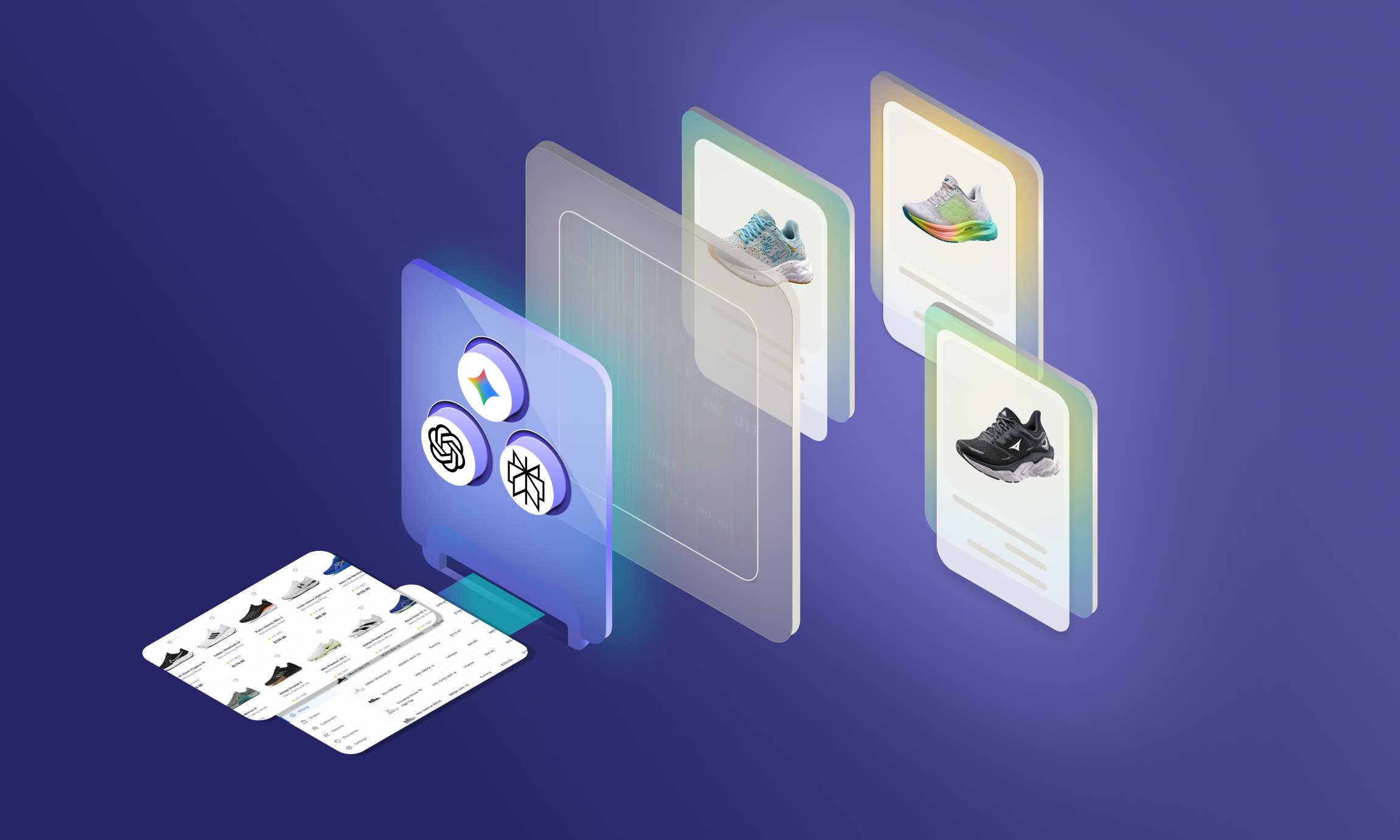
AI is bringing the conversation back. Instead of navigating a website, shoppers increasingly describe what they need in natural language and let AI research products, compare alternatives and return a shortlist. All of this happens often before ever visiting a brand’s website.
ChatGPT alone fields more than 2.5 billion prompts a day, and a meaningful share of those already relate to purchasable products, while referral traffic from AI platforms roughly doubled between the first and second half of last year. Gartner projects that a fifth of online shopping transactions could flow through AI platforms and agents by 2030.
For brands and retailers, this is changing the sales funnel itself. It doesn’t matter if your business has built exceptional digital experiences or invested heavily in SEO; if consumers can’t find your products on their preferred AI channel, they won’t know your brand exists or consider buying from you. That directly impacts website visits, conversion rates and revenue.
Becoming discoverable and buyable by AI — and ready to leverage the full potential of agentic commerce — won’t happen overnight. The AI readiness model for eCommerce helps guide that transition, with actionable insight into how your brand can move from one stage to the next.
What does becoming “ready” for AI commerce actually look like? We've defined five stages, each outlining:
The journey looks like this:
Let's dive in.
Most companies sit here today, even those with strong digital experiences. Products may never enter the AI conversation, not because they lack value, but because AI can’t reliably find, understand or trust the information it needs to recommend them. Fragmented product data, inconsistent content and missing attributes make products hard for AI to interpret, so it defaults to sources it can more easily verify.
This is the first shift companies need to internalize: AI doesn’t browse a website the way a person does. It relies on structured, machine-readable inputs. Indeed, data shows that pages with structured data see higher citation rates in tools like Google’s AI Overviews. Without that structure, a brand’s digital presence effectively disappears.
To move forward:
As experimentation gives way to real work, businesses recognize that AI is fundamentally a data problem. Product catalogs get structured, pricing gets standardized and fragmented systems start connecting through APIs.
The payoff: AI systems can now find you, and your products begin appearing in AI-generated recommendations. That’s the threshold from invisible to discoverable.
But discoverability alone isn’t enough. Inconsistencies still linger, from pricing mismatches to missing attributes. While people tolerate these gaps, AI systems are far less forgiving because trust is built on consistency at scale.
To move forward:
Once your data is consistent and your signals are reliable, AI systems move beyond surfacing your products to actively recommending them. Internally, this stage is often marked by real use cases — discovery agents, customer service agents, recommendation systems — usually deployed as focused, measurable pilots.
Externally, the impact is clear: You’re no longer just visible, you’re chosen. But the journey still stops short as AI can recommend you, but it can’t yet complete the transaction.
To move forward:
AI can now guide a customer toward a purchase, but completing the transaction remains a challenge. This is where many retailers get stuck: Intent is high, but the journey breaks when execution begins, because most commerce systems weren’t built for autonomous execution. Cart, checkout, inventory and order management often sit across disconnected platforms, and secure agent-initiated payments require tokenized, short-lived authorization that most checkout flows don’t yet support.
Consumers aren’t fully ready to hand over the wheel either. In fact, willingness to let AI make a purchase outright still peaks in the low double digits, even as most shoppers are already comfortable using AI to compare products and prices.
To move forward:
At the final stage, AI is drives the journey. Agents discover products, evaluate options, make decisions within defined preferences and complete transactions independently, initiating actions based on context. For example, reordering before something runs out, suggesting alternatives or managing post-purchase flows.
Internally, this demands real-time data flows, tightly integrated systems and governance frameworks that keep autonomy safe and aligned with business goals. Getting there at scale is the real bottleneck. Today, most businesses are already experimenting with AI agents, but only a fraction have moved from pilots to enterprise-wide scale.
Externally, the results are powerful: Your business becomes discoverable and shoppable in third-party AI channels like ChatGPT and Gemini, while brand-owned AI agents — for support, merchandising, dynamic pricing and more — complete closed-loop tasks with little to no human intervention.
To move forward (and scale):
For years, companies optimized for human interaction, assuming better human experiences naturally led to better business outcomes. And for a long while, it worked. AI changes that fundamentally: The “customer” may increasingly be an agent that must interpret your business, evaluate options and take action on its own.
To be visible and buyable by AI, businesses need to be structured for machine comprehension, reliable enough for automated decision-making, accessible across end-to-end workflows and designed to support governed action. The real transformation happens when AI shifts from a tool layered onto the business to an actor operating within it.
That’s what the AI readiness model captures: Success in AI and agentic commerce isn’t a question of channels, interfaces or tools. It's a question of architecture — data hygiene and standardization, security and trust, and end-to-end transactional APIs — so your business can leverage AI’s full potential.

eBook
The 5 Stages of AI Commerce Readiness
A practical guide for helping brands become discoverable, recommendable and transaction-ready in the age of AI shopping.

Manuela leads content strategy at commercetools. With over 20 years of experience in B2B SaaS, she writes about all things commerce by day and turns to fiction by night. She loves long walks, traveling, and, unsurprisingly, reading books.
Receive monthly updates on trends, products and growth insights in your inbox.