

Get in touch
Stay informed
Receive monthly updates on trends, products and growth insights in your inbox.





In industrial manufacturing, especially in spare parts and aftermarket services, the product catalog is often both a company’s most valuable asset and its biggest operational constraint.
Thousands of SKUs, multiple variants and configuration options, complex compatibility rules and fragmented documentation systems make it difficult for customers to quickly find the right part. In many cases, even identifying a single component requires contacting sales/support or relying on internal expertise, usually by digging up a previous order.
Product catalog capabilities within legacy commerce systems were never designed for complexity. To this day, technicians and service teams rely on static PDF catalogs, offline compatibility checks, quote requests via email/phone/fax, and repeated back-and-forth to confirm pricing, availability and orders.
What starts as a catalog limitation quickly turns into a fragmented procurement workflow:
The result is a system that actively slows down maintenance and service operations. Digitization fundamentally changes this, but only when it goes beyond simply “putting a catalog online.”
Industrial spare parts are fundamentally different from consumer eCommerce products. They aren’t typically discovered through a simple keyword search, but rather through context such as machine models or serial numbers.
At the same time, sellers operate across long-tail inventories where individual parts may have low transaction volume, but collectively represent a highly fragmented and operationally critical catalog. This creates challenges in accurately structuring, classifying and surfacing inventory to the right buyers.
For buyers, identifying the correct part within these complex catalogs is equally critical. Incorrect part selection can lead to production downtime, costly delays, equipment damage and broader operational disruption.
Procurement managers and field technicians who handle the purchase of spare parts need product catalogs designed for the operational realities of industrial environments, which include the following requirements:
The system must support how users actually identify parts in industrial settings, including:
Hybrid search workflows where technicians rely on both digital tools and human expertise, including contacting trusted suppliers, sales representatives or technical support personnel to validate part selection or troubleshoot ambiguous requirements.
This reflects the reality that industrial part identification is often iterative and collaborative, rather than a purely transactional search process.
The system must eliminate dependency on static or unstructured documentation by:
The system must reduce human-dependent validation by:
The system must eliminate disconnection between discovery and commercial information by:
The system must unify the full lifecycle from identification to purchase by:
Solving this challenge requires more than digitization. After all, converting PDFs into a digital interface doesn’t remove the underlying complexity; it only reshapes it.
The real shift happens when product data becomes structured, relational and machine-readable. This means a modern spare parts catalog is a data model where:
This is critical because industrial components, even more so in spare parts, don’t exist in isolation: A bearing, valve or sensor only becomes meaningful when mapped to the equipment it belongs to and works with.
Once product catalog data is structured this way, it enables intelligent discovery, guided navigation and compatibility validation, laying the foundation for AI-assisted identification and automation, as well as agentic commerce.
Digitizing a catalog goes beyond a product data challenge; it’s also an organizational one.
Many industrial manufacturers operate as a “house of business lines” or a federation of regional subsidiaries. Over time, this leads to fragmented digital infrastructure:
This fragmentation becomes a serious barrier to scaling digital commerce. Every new market, acquisition or brand adds complexity instead of leveraging shared infrastructure.
A modern commerce architecture needs to solve this without forcing destructive consolidation.
This is where a multi-project / multi-catalog approach becomes critical, allowing manufacturers to:
This separation of concerns is essential for scaling industrial eCommerce. Without it, every expansion becomes a re-platforming exercise rather than a configuration change.
A strong example of this transformation is Normet, a leading manufacturer of underground mining and tunneling equipment.
Before launching its online store, Normet faced a challenge common in industrial manufacturing: An extremely large and complex spare parts ecosystem comprising over 65,000 highly specialized components.
In a traditional offline environment, this created significant limitations:
By digitizing its spare parts ecosystem, Normet enabled customers to interact with the full catalog in a structured, searchable and self-service environment. Instead of relying on manual support, buyers are now able to discover, compare and validate parts directly online.
Today, the Normet Store offers genuine spare parts spanning engine, hydraulic, electrical and wear-resistant components, with product data that includes personalized pricing, real-time inventory data and streamlined ordering.
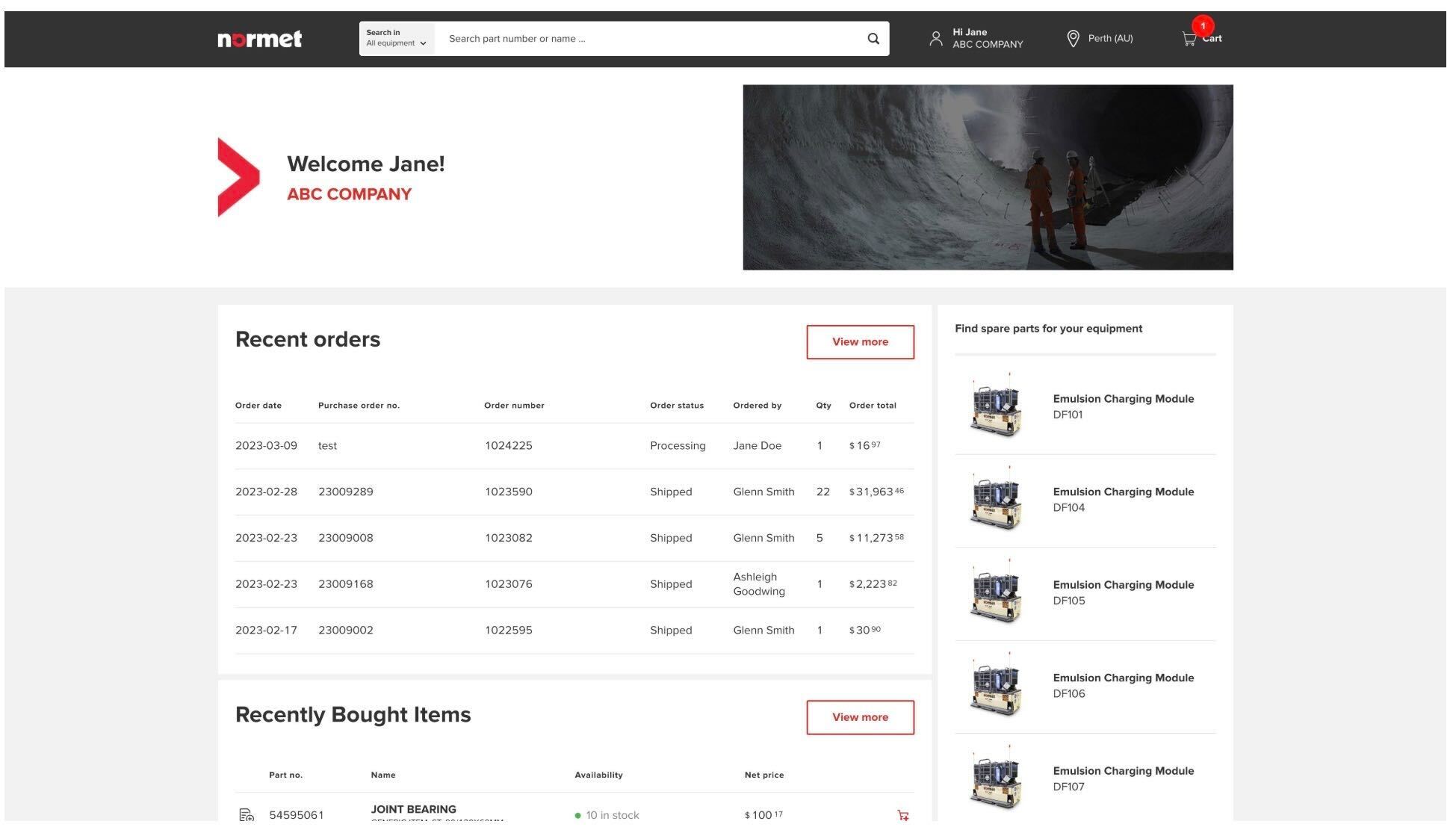
Normet Store, available in Australia, Canada and the US, features an intuitive interface for seamless catalog exploration, enabling buyers to swiftly locate precise spare parts using user-friendly search and filtering tools, customized to their specific fleet’s equipment or part numbers. The streamlined ordering process ensures effortless procurement with only a few clicks.
Once visibility increases, so does the likelihood of discovering related components, upgrades and additional maintenance items. The impact is commercial expansion — and a lift in revenue.
Beyond providing an intuitive self-service experience that helped them grow revenue sustainably, Normet also experienced operational efficiency gains from this digital spare parts offering, lowering incoming call volumes to their service and support teams by over 30%.
When structured product intelligence and multi-catalog architecture come together, the role of the catalog fundamentally changes:
Just as with Normet, the product catalog stops being a cost center and becomes a growth engine, enabling manufacturers to generate new revenue streams while significantly improving efficiency across the board.

White Paper
B2B Commerce Buying Guide
Get the guide to help you evaluate requirements and capabilities for modern B2B commerce platforms.

With over a decade of experience across product and marketing teams in the tech world, Julia specializes in creating innovative, customer-first strategies and driving cross-functional growth and go-to-market initiatives.

Manuela leads content strategy at commercetools. With over 20 years of experience in B2B SaaS, she writes about all things commerce by day and turns to fiction by night. She loves long walks, traveling, and, unsurprisingly, reading books.
Receive monthly updates on trends, products and growth insights in your inbox.