

Get in touch
Stay informed
Receive monthly updates on trends, products and growth insights in your inbox.



Today’s consumers aren’t a monolith — billions of people shop globally, each with unique preferences and behaviors. Still, clear patterns are emerging in how people discover, evaluate and buy, highlighting where brands must focus attention.
Younger generations entering the workforce — or accessing spending power via parents — often reshape shopping habits through new channels and technologies, from social media to AI-driven experiences. Expectations are increasingly personalized and context-dependent, shaped by culture, region and lifestyle.
A new type of consumer is also emerging: The AI agent. Acting on behalf of a person, it can research, compare and even shop autonomously. By 2030, nearly 50% of online shoppers are expected to use AI agents, accounting for ~25% of their spending, adding $115B to the US eCommerce sector.
While humans still call the shots, brands may need to appeal to AI as a gatekeeper by providing structured, AI-ready catalogs and data — a scenario that’s becoming increasingly plausible in 2026.
True engagement, however, requires segmentation beyond demographics — by behavior, context and intent. To help retailers operationalize these expectations, we highlight 10 consumer archetypes every retailer needs to know.
These archetypes are not rigid. Consumers of all generations may use social media or AI, while younger consumers can be digitally conservative. The goal is to understand behavioral patterns that influence engagement and purchase decisions.
Some consumers shop traditionally, others rely on social feeds or AI agents and many shift between channels depending on product, urgency or context. Even within the same generation, behavior varies by moment and need.
This makes one-size-fits-all strategies ineffective. Optimizing solely for specific channels in isolation, such as search, social, AI or stores, will inevitably overlook segments of demand.
The opportunity lies in operationalizing nuance: Detecting intent in real time, segmenting dynamically and delivering context-aware experiences. Retailers that build for variability — rather than averages — will capture relevance, trust and revenue in an increasingly fragmented landscape.
This focus on nuance naturally leads to a broader question: What does an exceptional experience look like in 2026?
White Paper
Reimagining Retail Commerce in 2026
To explore the emerging trends, technologies, and opportunities driving it forward, download our white paper.
Today’s consumers are more empowered, connected and discerning than ever. They judge brands not only on what they sell, but on how they make them feel, how they anticipate their needs and how easily they help them get what they want — wherever and whenever that is.
For many retailers, defining an “exceptional experience” has become more challenging because the yardstick has shifted. An exceptional experience is no longer a single moment — it’s a continuum of interactions that must feel intuitive, relevant and frictionless across touchpoints.
With the rise of agentic commerce, the bar is rising again. AI-driven channels increasingly influence not just discovery and decision-making, but also fulfillment and loyalty. Consumers adopting AI expect experiences that feel seamless, whether they’re interacting directly or through an AI agent acting on their behalf.
Across these pillars, the common thread is context — understanding not just who consumers are, but why, when and how they choose to engage.
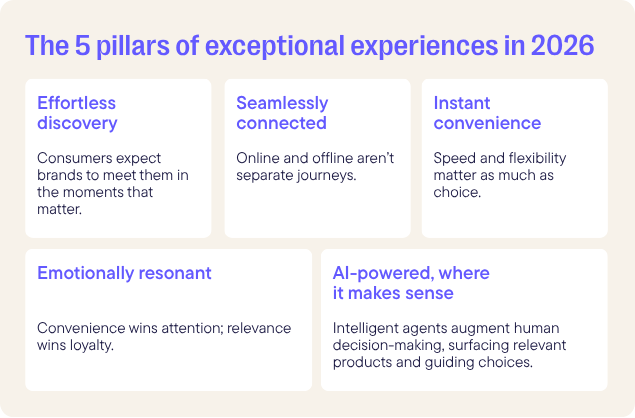
Consumers want inspiration everywhere: In social feeds, marketplaces, search engines, storefronts, and increasingly, through AI agents. Discovery must feel effortless, contextual and personalized.
Consumers today expect the right information at precisely the moment it matters — whether they’re evaluating specs, reading reviews or checking ratings. They no longer have the patience to hunt across multiple sites or dig through product pages; every delay introduces friction and increases the likelihood of abandoning the purchase.
While social media plays a significant role in product discovery, with 69% of Gen Z consumers saying it’s their primary way of finding new products or brands, AI agents are emerging to amplify discovery even further by proactively surfacing products, curating “inspiration feeds,” highlighting trending items across multiple channels, comparing products and presenting curated options that match both preferences and practical needs.
By delivering the most relevant information at the right time, these tools reduce decision fatigue, accelerate purchase decisions and make the entire shopping experience feel smarter and more personalized. The shift is already happening as 60% of shoppers expect to use AI agents within the next 12 months, and 73% are familiar with AI tools.
Consumers no longer distinguish between online and offline channels — they simply want the journey to work. For instance, a large portion of shoppers want to research online, reserve a product for in‑store pickup, check inventory before making the trip and complete the purchase later via mobile app or in person.
According to CapitalOne Shopping, 86% of shoppers start their product research online, even if they ultimately buy in-store.
Many physically browse items on the sales floor while simultaneously consulting digital reviews, ratings and product details on their phones — blending the convenience of eCommerce with the sensory experience of in‑store exploration.
What’s more, real‑time inventory visibility has become a must-have in the shopping journey. Now, 73% shoppers expect to use digital channels to check stock before visiting a store, and many will abandon the trip entirely if they can’t see that the product is available.
Consumers want choice — and they want it fast — across every stage of the shopping journey. Convenience starts with checkout to encompass delivery, pickup, returns and post-purchase support.
Traditional points-based programs are no longer enough. Consumers now look for experiences that feel personal, meaningful and aligned with their values:
AI agents increasingly act on behalf of consumers to identify rewards, redemption opportunities and engagement points. They may choose brands based on which programs deliver the best mix of convenience, personalization and value. In other words: Loyalty programs now compete for approval from both humans and their AI proxies.
Customers have varying comfort levels with AI autonomy, depending on their generation, region and purchase type (e.g., groceries, luxury or healthcare). Ignoring this gap can limit adoption and reduce conversion rates, even with advanced technology.
Following the principle of progressive delegation, brands and retailers can enable customers to control the level of autonomy they grant their agents, ranging from advisory guidance to full delegated execution. This approach enables optional autonomy rather than forced automation, fostering confidence and facilitating gradual adoption.
Exceptional experiences in 2026 won’t be defined by a single interaction or channel, but by how well brands adapt to constant variability. Consumers will move fluidly between physical stores, digital platforms and AI-mediated journeys, often within the same purchase.
The retailers that succeed will be those that embrace this complexity: Building systems that understand intent in real time, connect every touchpoint and balance human needs with intelligent automation. In a landscape shaped by both people and their AI agents, relevance isn’t just a competitive advantage — it’s the foundation of lasting growth.
White Paper
Reimagining Retail Commerce in 2026
To explore the emerging trends, technologies, and opportunities driving it forward, download our white paper.

Manuela leads content strategy at commercetools. With over 20 years of experience in B2B SaaS, she writes about all things commerce by day and turns to fiction by night. She loves long walks, traveling, and, unsurprisingly, reading books.
Receive monthly updates on trends, products and growth insights in your inbox.