

Get in touch
Stay informed
Receive monthly updates on trends, products and growth insights in your inbox.





B2B sales teams are drowning in manual data entry as reps spend substantial time on manual order handling and administrative data entry. The reason? Many buyers submit orders through email, PDFs, Excel files or other unstructured formats rather than structured digital checkout flows. Vague descriptions like “the red compressor I saw two weeks ago” also end up in salespeople’s inboxes.
As a result, the rep goes through the following actions:
And only then sends it back to the customer.
This can take anywhere from 30 minutes to a few days, depending on the complexity of the incoming request and the internal systems involved. The seller then waits for a PO (Purchase Order), manually attaches it to the opportunity and hands it to order entry. The result: 350 quotes per month is the hard ceiling of what the physical team can process. Does this sound familiar?
Market data proves this is an issue more widespread than initially thought:
The problem with manual order intake goes beyond the effective use of salespeople’s time. It also introduces measurable error risk: 1-3% of manual entries, such as invoicing, pricing and contract data, are incorrect and require manual intervention. That makes the process not only slower for B2B sellers but also — and especially — for buyers, introducing more friction and lengthening sales cycles, in a world where instant answers are expected.
Many B2B organizations agree that manual data entry and processing is their #1 bottleneck in their sales operations. When sales reps handle ~200 quotes/week per rep with a 2–3 week turnaround or clerks spend 30–60 minutes manually entering a 50-line order, the problem is more than a simple case of operational inefficiency. It directly increases costs and impacts revenue potential.
AI, automation and data-driven workflows are fundamentally reshaping the definition of productivity. Data shows that AI has arrived in B2B eCommerce:
Instead of requiring sales teams to manually interpret emails, PDFs, spreadsheets or vague product descriptions, agentic systems can understand intent, map it to the correct catalog items, apply customer-specific pricing and discounts, and automatically generate structured quotes or carts, all while keeping the humans in the loop for where their expertise adds value.
This matters because B2B order intake is inherently complex: It depends on customer contracts, business units, pricing agreements, product availability and approval rules. Traditionally, humans would bridge all of this manually, which slows down sales processes, introduces errors and creates a subpar customer experience.
Agentic commerce can remove this bottleneck by combining AI reasoning with real-time commerce data and business rules. The result is:
So, how can agentic commerce actually solve the unstructured data problem that so many manufacturers, distributors and wholesalers face?
The “offline-to-order” bottleneck is today’s reality for a large portion of B2B organizations, and it’s unlikely that it will change anytime soon, as customers who currently send requests via email, PDFs, phone calls and vague descriptions of what they need will continue to do so. The problem isn’t how customers are sending orders, but how these orders are processed internally. This is where agentic commerce — and commercetools’ B2B Intake Agent, more specifically — can help.
The B2B Intake Agent is a seller-side, API-first AI assistant that converts unstructured buyer requests into structured quotes or carts across any channel.
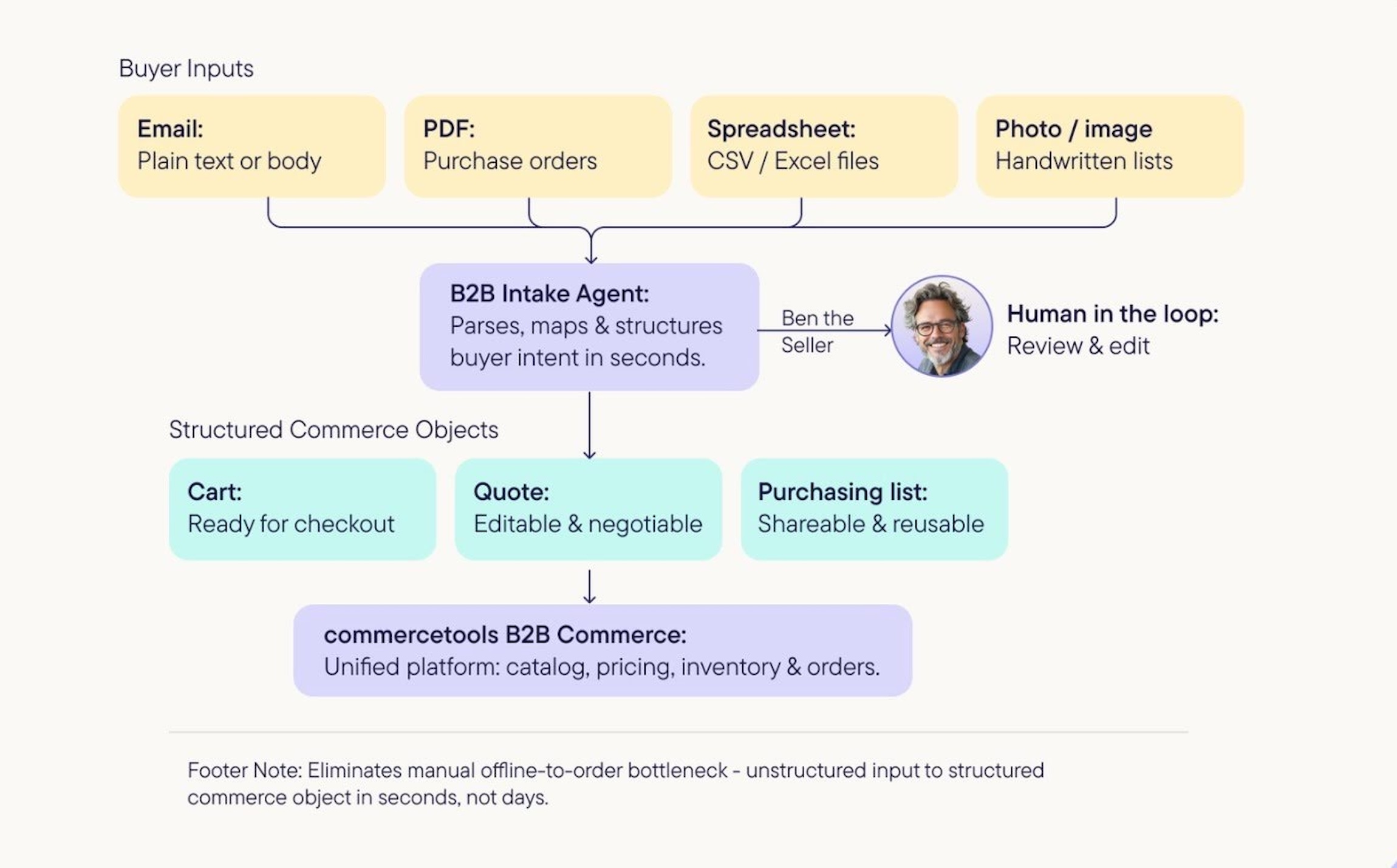
What the B2B Intake Agent does:
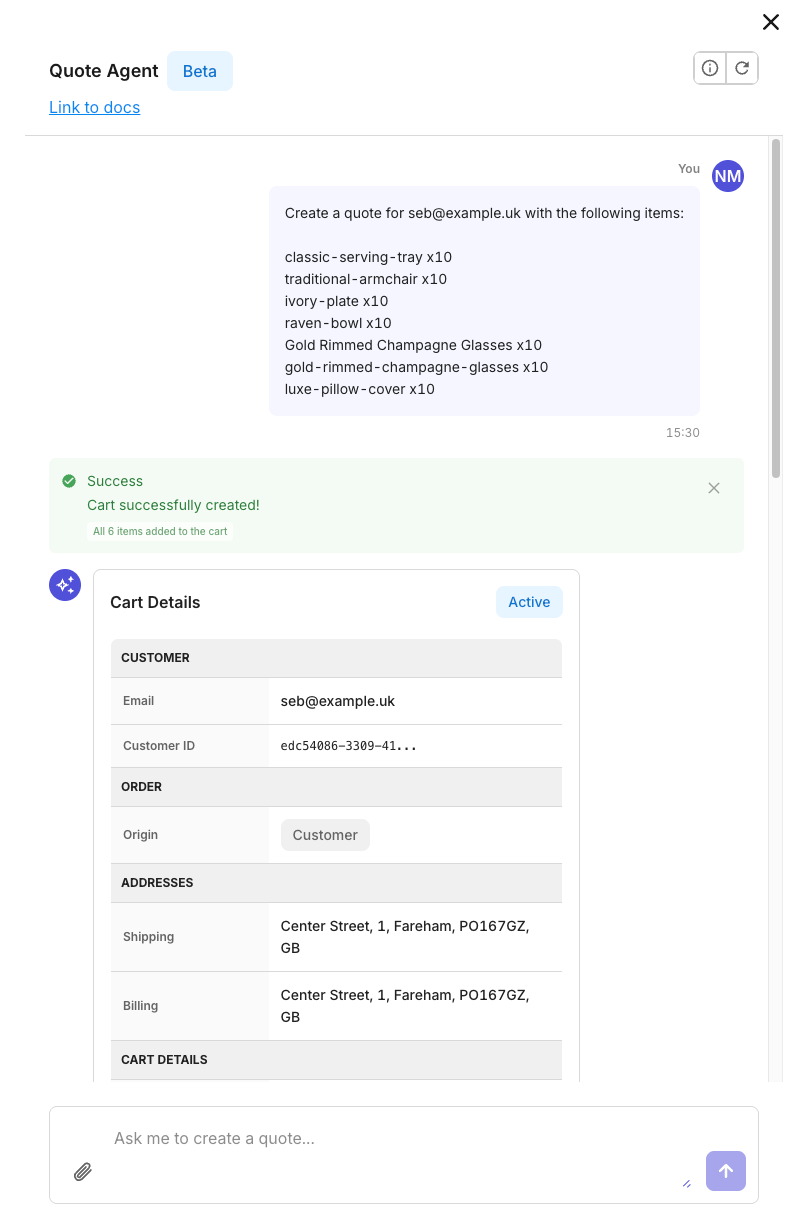
Unlike disconnected AI tools or external intake systems, commercetools’ B2B Intake Agent works natively within commercetools’ unified commerce ecosystem, mapping unstructured inputs directly to catalog data, business units, customer-specific pricing, entitlements and discounts without requiring separate orchestration layers or custom middleware without the need for an MCP server.
By harmonizing products, customer accounts, pricing, business rules and organizational structures in a single platform, the agent can accurately interpret and convert complex intake requests into actionable carts and orders with minimal human intervention.
In addition, the B2B Intake Agent differentiates in the following ways:
Future-proof by design: As B2B commerce rapidly evolves toward AI-assisted buying and quoting experiences, the Intake Agent enables organizations to adopt emerging AI capabilities without being constrained by legacy architectures. Businesses can integrate new LLM-driven parsing, intelligent product matching and AI-assisted cart generation capabilities as the market evolves, helping them move faster than competitors dependent on rigid legacy commerce systems.
Integrations and sync: The Intake Agent is designed to integrate seamlessly into complex enterprise environments. It can connect with ERP systems for inventory and fulfillment data, CRMs for customer context, pricing engines, procurement workflows and custom SKU mapping logic, enabling businesses to automate highly specialized B2B processes with the technologies they already have in place, without extensive replatforming or brittle custom solutions.
Enterprise-grade automation for complex B2B operations: The Intake Agent supports the realities of enterprise B2B commerce, including large catalogs, negotiated pricing, customer-specific assortments and multi-business-unit purchasing structures. By embedding AI-driven intake directly into commerce operations, organizations can improve speed, reduce order-entry errors and increase sales team productivity while maintaining governance, accuracy and operational control.
With the B2B Intake Agent, businesses can accelerate sales workflows while reducing operational complexity. The result is a faster, more scalable and AI-ready approach to B2B order intake that improves both customer experience and internal productivity.
The Intake Agent helps businesses respond more quickly to order entry and customer purchasing decisions by automating the translation of unstructured requests into carts and quote drafts.
Sales and service teams can:
By reducing friction in the buying journey, businesses can improve their conversion rates, accelerate deal cycles and increase customer satisfaction. Faster and more accurate order intake workflows also create opportunities to increase average order value (AOV) and customer lifetime value (CLV) through more efficient sales engagement.
Because the Intake Agent is built natively on Sphere, the commercetools platform, these same capabilities also establish the foundation for future AI-driven B2B sales experiences, including autonomous quoting, intelligent product recommendations and other agentic commerce workflows.
The Intake Agent eliminates the need for sales teams and customer service representatives to spend hours manually interpreting customer documents, re-entering product data and validating pricing across disconnected systems.
Instead of relying on fragmented intake workflows and custom integrations, businesses can centralize AI-driven order intake directly within the commerce platform, where other digital orders already live. This helps organizations:
By automating repetitive administrative work, businesses can free sales teams to focus on higher-value customer engagement and revenue-generating activities rather than manual processing tasks. The result is more efficient, scalable and future-ready B2B commerce operations.
With commercetools’ B2B Intake Agent, businesses can move from fragmented, manual order processing to an AI-driven, fully integrated order intake experience that works natively across their existing commerce ecosystem.
This means businesses can start:
Ready to explore the B2B Intake Agent? Contact us for more information.

Anastasia Drougka is a Staff Product Manager at commercetools. She has 10 years of experience in eCommerce and has worked with a number of different industries across the globe as an eCommerce specialist.

With over a decade of experience across product and marketing teams in the tech world, Julia specializes in creating innovative, customer-first strategies and driving cross-functional growth and go-to-market initiatives.
Receive monthly updates on trends, products and growth insights in your inbox.