
Get in touch
Stay informed
Receive monthly updates on trends, products and growth insights in your inbox.



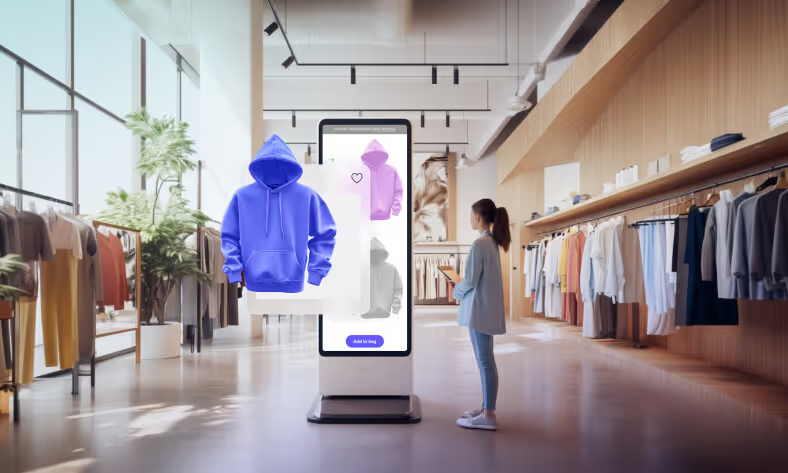
It’s often the case that shoppers are looking for specific products when arriving at a brick-and-mortar store. It also happens quite often, unfortunately, that most of them will leave empty-handed, as the items they seek aren’t in stock at the store. More than a lost sale, retailers have disappointed a customer who may think twice before returning.
According to recent research, this gap leaves retailers losing 10-30% of potential in-store sales. Moreover, retailers lose a staggering US$1.75 trillion every year due to overstocked or out‑of‑stock inventory, as well as preventable returns.
Clearly, retailers must strike a balance between breadth and depth to serve the vast majority of clients who come in, as stocking every product across numerous colors, sizes and other variants is impractical and costly.
The solution: Endless aisle enables retailers to cater to every shopper’s wish and recover in-store revenue without having to overstock products or sacrifice customer service.
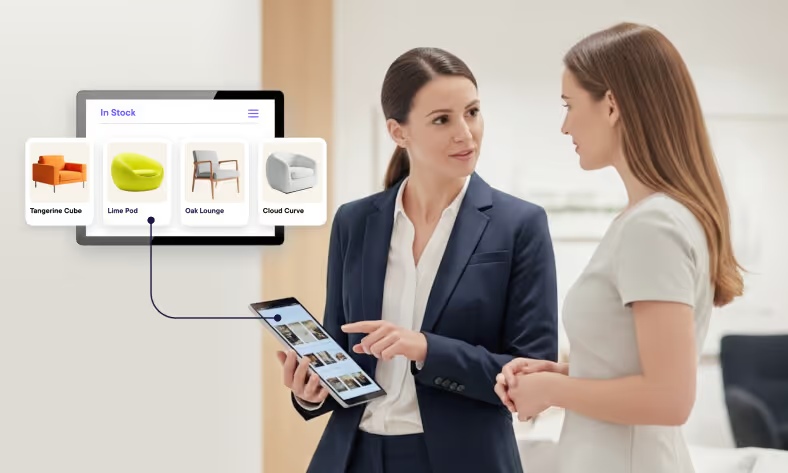
Endless aisle is the ability to provide in-store customers with the opportunity to order products that are either out of stock or not available in the store’s inventory. Store associates can retrieve real-time inventory information on the desired product(s) and offer the customer the option to:
Research shows that endless aisle is a must-have for the majority of consumers: 68% of them expect store associates to sell products that aren’t available in-store and ship them according to their preferences.
More than powerful checkout functionality, endless aisle provides a fluid, customer‑centric experience where the shopper is in control, with the store serving as a facilitator of choice.
Endless aisle is more than a tool to save a sale; it’s a strategy that fundamentally elevates the retail experience:
When customers can’t find what they want in-store, endless aisle gives them a reason to stay. For retailers, that means capturing a significant share of transactions that would otherwise walk out the door.
Retailers no longer have to choose between shelf space and choice. Endless aisle lets them showcase everything, without the cost of carrying all inventory in every location.
Customers who find what they want — exact item, size or variant — are more likely to return. With personalization and profile integration, the experience becomes memorable rather than transactional, helping boost loyalty.
By optimizing inventory across locations and channels, retailers reduce overstocks, cut down warehouse costs and move products faster without markdowns or waste.
To do endless aisle well, retailers need more than a digital catalog bolted onto a store. They need a unified commerce foundation, where channels don’t compete, duplicate or contradict each other, but operate as one cohesive system.
At its core, unified commerce replaces fragmentation with fluency. It ensures that when a customer asks, “Can I get this in a different size?” the answer isn’t limited by the four walls of the store. Instead, it draws from a living, connected ecosystem of inventory, data and fulfillment capabilities.
That foundation rests on a few non-negotiables:
Another layer that’s often underestimated and it’s where unified commerce truly differentiates itself: Empowering store associates with data. Endless aisle only works when associates are equipped to act as informed advisors. This means:
This level of enablement is only possible when systems are unified. If inventory lives in one system, customer data in another, loyalty in a third and order management somewhere else, associates are forced to toggle, guess or defer. That erodes confidence for both the store associate and the customer.
Endless aisle is often seen as a retail innovation, but it can also benefit many other industries. Let’s explore some use cases that show how it extends well beyond traditional retail and can be combined with other scenarios.
Fashion brands were early adopters of the endless aisle, but the real opportunity isn’t just extended size runs — it’s deeper relationships.
Use case: A customer visits a flagship store looking for a blazer in a specific color and size. It’s not in stock locally.
With unified commerce:
Impact:
In categories like furniture, appliances or home improvement, floor space is expensive. Displaying every SKU is impossible.
Use case: A customer visits a furniture showroom and loves a sofa, but wants a different fabric and configuration.
With unified commerce:
Impact:
In grocery stores, space is even tighter and demand is volatile.
Use case: A customer is looking for a specialty dietary product that’s not carried in-store.
With unified commerce:
Impact:
Endless aisle thinking becomes even more powerful in B2B, where orders are complex and relationships are long-term.
Use case: An industrial equipment sales rep visits a manufacturing client. The client needs replacement components and is considering upgrading machinery.
With unified commerce:
Impact:
In healthcare, stockouts aren’t just inconvenient; they’re risky.
Use case: A hospital department urgently needs a specific medical device.
With unified commerce:
Impact:
Many manufacturers now operate hybrid models: Wholesale, direct online and physical brand spaces.
Use case: A customer interacts with a brand showroom but prefers delivery to their home country.
With unified commerce:
Impact:
With commercetools, endless aisle isn’t an add-on feature layered on top of legacy systems. It’s a natural outcome of a composable, API-first architecture designed for unified commerce from the start. There are two ways businesses can start configuring endless aisle on commercetools.
commercetools B2C Commerce enables brands to create seamless shopping journeys across digital environments using a centralized product catalog management, real-time inventory visibility across multiple locations, cart and checkout solutions and more — all powered by API-first integration capabilities that enable data to flow.
In this solution, enterprises can integrate existing systems where needed, including POS platforms, for a consistent view of products, customers, inventory and order lifecycle.
Where many commerce platforms stop at eCommerce, commercetools extends unified commerce directly into the store environment with the InStore solution, a modern POS solution for businesses to unify store and digital channels, preventing system duplication or silos.
This solution is ideal, particularly for retailers that plan to seamlessly connect their brick-and-mortar stores with digital capabilities to convert sales at every touchpoint faster. This solution provides store associates with all the data they need to better serve customers — delivered out of the box.
Endless aisle turns every store into a connected node within a larger commerce network rather than a space limited by its four walls.
The same unified commerce foundation that enables endless aisle also powers:
More importantly, it creates the conditions for consistent personalization, smarter inventory optimization and flexible fulfillment across every channel.

White Paper
The Unified Commerce Playbook for Retail Leaders
Discover how brands and retailers can unlock the benefits of unified commerce.

Phillip Hoffman has more than 15 years of experience in consulting and solution design. He has worked across the globe with large brands, retailers and telcos, helping them with major business initiatives around digital content, as well as to design solutions that intelligently blend content and commerce.

Manuela leads content strategy at commercetools. With over 20 years of experience in B2B SaaS, she writes about all things commerce by day and turns to fiction by night. She loves long walks, traveling, and, unsurprisingly, reading books.
Receive monthly updates on trends, products and growth insights in your inbox.