Get in touch
Stay informed
Receive monthly updates on trends, products and growth insights in your inbox.







Customers love the convenience of flexible fulfillment options, providing the kind of service that keeps them coming back for more, such as:
Despite this popularity, many retailers aren’t yet in a position to offer fulfillment options that meet customer expectations. Still today, many retailers operate with disconnected systems: One for online orders, another for store inventory and a third for warehouses. This often leads to:
The issue is clear: Frustrated customers, stressed associates and missed revenue opportunities.
This is where unified fulfillment comes in.
Unified fulfillment enables retailers to orchestrate orders and inventory across all channels (online, in-store, mobile and social) through a centralized dataset.
Unlike traditional integrations or point-to-point systems, it provides:
Think of it as the brain behind omnichannel operations: More than data traveling through systems, it coordinates actions, ensures updates happen in real time and keeps every team aligned.
Let’s follow a customer journey that illustrates how unified fulfillment works in practice:
Scenario: A customer shopping online is looking for a specific jacket.
1. Browsing with confidence: Real-time inventory shows the jacket is out of stock for home delivery but available at a nearby store.
2. Flexible checkout: The customer selects BOPIS, knowing the item will be ready upon arrival.
3. Automated store execution: The order is routed instantly to the selected store. The associate sees it in real-time, selects the item and confirms fulfillment. No manual reconciliation or double-checking across multiple systems is required.
4. Inventory automatically updates: As soon as the item is picked, online and in-store inventories are updated. Other customers see accurate stock immediately.
5. Enhanced in-store experience: When the customer arrives, pickup is seamless. Associates can offer add-ons, styling advice or loyalty perks without slowing the process.
This journey reduces friction at every touchpoint, from browsing to checkout to pickup. Both customers and store teams benefit.
Many retailers employ “integrated” approaches, which involve multiple systems connected via data synchronizations or APIs. Technically, it enables omnichannel, but in reality, it often breaks down due to:
For instance, 95% of retailers still manually synchronize multiple systems, a clear sign that integrated fulfillment systems can’t keep up with the real-time data and various options that customers expect today.
Unified fulfillment solves these problems by operating on a single source of truth. Every system — online, in-store or warehouse — shares the same real-time data. The result? Reliable execution, fewer errors and reduced operational stress.
Legacy POS systems are fundamentally channel-centric, which limits their ability to support truly unified fulfillment. Even when POS, OMS and eCommerce platforms are integrated, retailers are still operating multiple systems with separate data sources, rather than a single, shared view of inventory and orders.
While modern POS systems are a step in the right direction toward better fulfillment experiences, most operate as standalone solutions. This means they’re integrated with other systems, like eCommerce and OMS, but don’t share a single source of truth, so they struggle with similar issues, such as delayed sync for interactions that should happen instantly.
As a result, fulfillment scenarios like BOPIS, ship-from-store, endless aisle and cross-store fulfillment technically exist, but often fail in execution.
The impact is measurable. While many retailers recognize that real-time inventory visibility and flexible fulfillment are critical to customer satisfaction and revenue growth, far fewer can execute these scenarios reliably at scale. The gap highlights the challenges of delivering consistent fulfillment when legacy platforms are stitched together rather than unified.
Many retailers attempt to bridge channels using standalone POS or eCommerce systems, but these approaches fall short of true unification:
In practice, fulfillment managed through channel-specific systems often leads to:
The difference is clear: Unified commerce enables retailers to centrally orchestrate inventory and orders, using real-time data across all channels and locations. This ensures that fulfillment promises made at checkout can be executed reliably in stores without requiring manual workarounds or placing undue operational strain.
Finally, the data from the study conducted by Manhattan and Google Cloud show that 31% of retailers with higher unified commerce maturity reduced last-mile delivery costs, and 24% experienced fewer stockouts through improved inventory accuracy and fulfillment visibility.
When unified fulfillment is in place, enterprises can experience measurable outcomes:
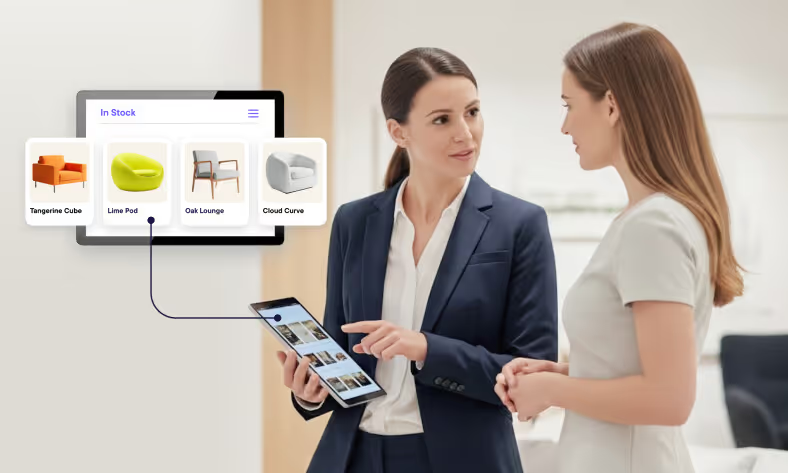
Real-time stock levels across stores, warehouses and marketplaces. The unified inventory displays where products are available in nearby stores.
Example: If a customer searches for a popular sneaker online, unified inventory ensures only stores with stock show availability. No overselling, no cancellations.
Orders — online, in-store or mobile — are processed consistently in a single system, eliminating errors, duplication or misrouting. Store associates no longer need to perform manual reconciliation.
Example: A ship-from-store order automatically prioritizes the closest location with available stock, ensuring faster delivery.
Retailers can dynamically route orders, optimize fulfillment and empower store associates.
Example: A unified system ensures that the return is processed correctly, the inventory is updated and any loyalty or promotional credits are applied. This ensures that operations run smoothly and customer promises are fulfilled.
Store associates spend less time troubleshooting orders or reconciling inventory mismatches. They can perform faster pickups for customers, spend more time with assisted selling and personalized service, avoid unnecessary escalations and reduce returns.
Example: Associates can upsell accessories or services because they’re not bogged down fixing inventory errors.
Consistently keeping fulfillment promises builds trust. Customers return more often when they know what they see online matches reality, and their experience is smooth from checkout to pickup.
Real-time inventory and unified fulfillment are foundational capabilities for retailers scaling omnichannel operations. It provides:
Unified fulfillment is real-time, reliable and operationally smart. Retailers who embrace it can confidently offer flexible fulfillment options without compromise, keeping both customers and associates happy.
With commercetools’ unified commerce approach, inventory and fulfillment are orchestrated from a single foundation, enabling retailers to execute these experiences consistently across every channel.

White Paper
The Unified Commerce Playbook for Retail Leaders
Discover how brands and retailers can unlock the benefits of unified commerce.

Ankita is a product marketing professional at commercetools and is passionate about developing value-based product messaging to communicate the vision and value of their products to the market. She has lived and worked in five different countries and navigated roles in the consulting and financial services industry before transiting into eCommerce post MBA.
Receive monthly updates on trends, products and growth insights in your inbox.