

Get in touch
Stay informed
Receive monthly updates on trends, products and growth insights in your inbox.





You’ve likely read that 67% of B2B buyers now prefer a rep-free sales experience. So does that mean that once you’ve launched an industrial eCommerce site, orders will roll in? Not necessarily.
Industrial and manufacturing buyers often abandon carts mid-way through a digital sale. This isn’t due to loss of interest, but rather workflow complexity.
For instance, many buyers send over requests through spreadsheets, emails or Word documents to sales reps, who take pains to convert this unstructured data into a quote or an order that they can send back to the buyer. This manual process adds friction at every step of the purchasing process, ultimately lengthening the time it takes sales reps to come back to buyers.
In addition, it often happens that sales reps need to help buyers navigate configurations for Bills of Materials (BOMs), spare parts and kits, and that’s not always available in a digital format. Finally, sellers may not be able to populate negotiated pricing and contract entitlements online, or the system may lack the ability for multiple stakeholders to review and approve the order.
So, while 71% of B2B buyers say they’re willing to spend over US$500,000 on an online order, many of them end up abandoning their carts or requests for quotes.
For B2B manufacturers, distributors and wholesalers exploring ways to reduce cart abandonment and reignite buyers’ interest, this guide will cover how to remove friction in the buying journey — and recapture that lost revenue.
Industrial eCommerce journeys often break at scale due to slow, complex cart-building and manual steps required to finalize orders. Distribution and wholesale orders are often high-volume, multi-line and repetitive, with parts of the sales process taking place offline. Manufacturing sales add more complexity, such as technical validations, substitutions and custom configurations.
B2B eCommerce for industrial manufacturing usually gets stuck at two points in the buying journey: Data intake and order finalization.
Traditional industrial buying relies on manual processes and data entry to convert unstructured data in PDFs or spreadsheets into an order. Customers may struggle to find the exact spare parts they need in a sales portal or give up due to the slow cart-building process. Similarly, reps building a cart on behalf of customers find it’s too time-consuming and not scalable or cost-effective when dealing with dozens of line items per order and hundreds of orders per week.
The second bottleneck happens when finalizing an order. Steps like the ones below may slow down or prevent an order from being placed:
Product or pricing errors that go undetected can also lead to costly administrative fixes, erode confidence in the online system and even cost future business from that customer. In short, the stakes are too high for B2B manufacturers and wholesalers to leave 100% of the intake and sales process to a static interface. What we call abandonment is often a symptom of a lack of operational support, not a UX failure.
While a functioning eCommerce website is necessary for industrial sellers and wholesalers to compete, it isn’t a silver bullet. Gartner found that B2B buyers engage with companies through an average of 12 sales channels today, up from just five in 2016. Customers want omnichannel experiences and the choice to place orders through traditional ordering, online ordering, or a hybrid of the two.
Hybrid sales, also called rep-assisted selling, is the middle ground that combines the convenience and automation of self-service with the engagement and expertise of traditional sales. Reps can step in at key moments in the buying journey to affirm value, speak to different stakeholders and address technical issues.
Here’s what the research shows about hybrid sales:
A hybrid approach to B2B manufacturing sales can remove friction in the buying process and build confidence in the sale. AI agents can also aid buyers in finding products, answering questions and building carts. A three-strand approach of self-service, sales rep assistance and AI agent assistance is a recipe for a streamlined, successful purchasing journey.
In B2B manufacturing, abandonment can happen at multiple stages. To solve the biggest bottlenecks, commercetools launched two capabilities that help industrial manufacturers, distributors and wholesalers minimize cart abandonment:
Together, these capability layers connect offline intent to structured commerce and support buyers through order finalization and checkout. Here’s how each one works.
Most organizations focus exclusively on the checkout experience, but in industrial buying, the cart is often not where deals are won or lost. The B2B Intake Agent addresses friction before the cart exists. Many industrial orders arrive as unstructured inputs that must be manually converted before a commerce platform can process them. This is a pre-cart problem, and some orders never make it past this stage.
How commercetools’ B2B Intake Agent solves intake friction
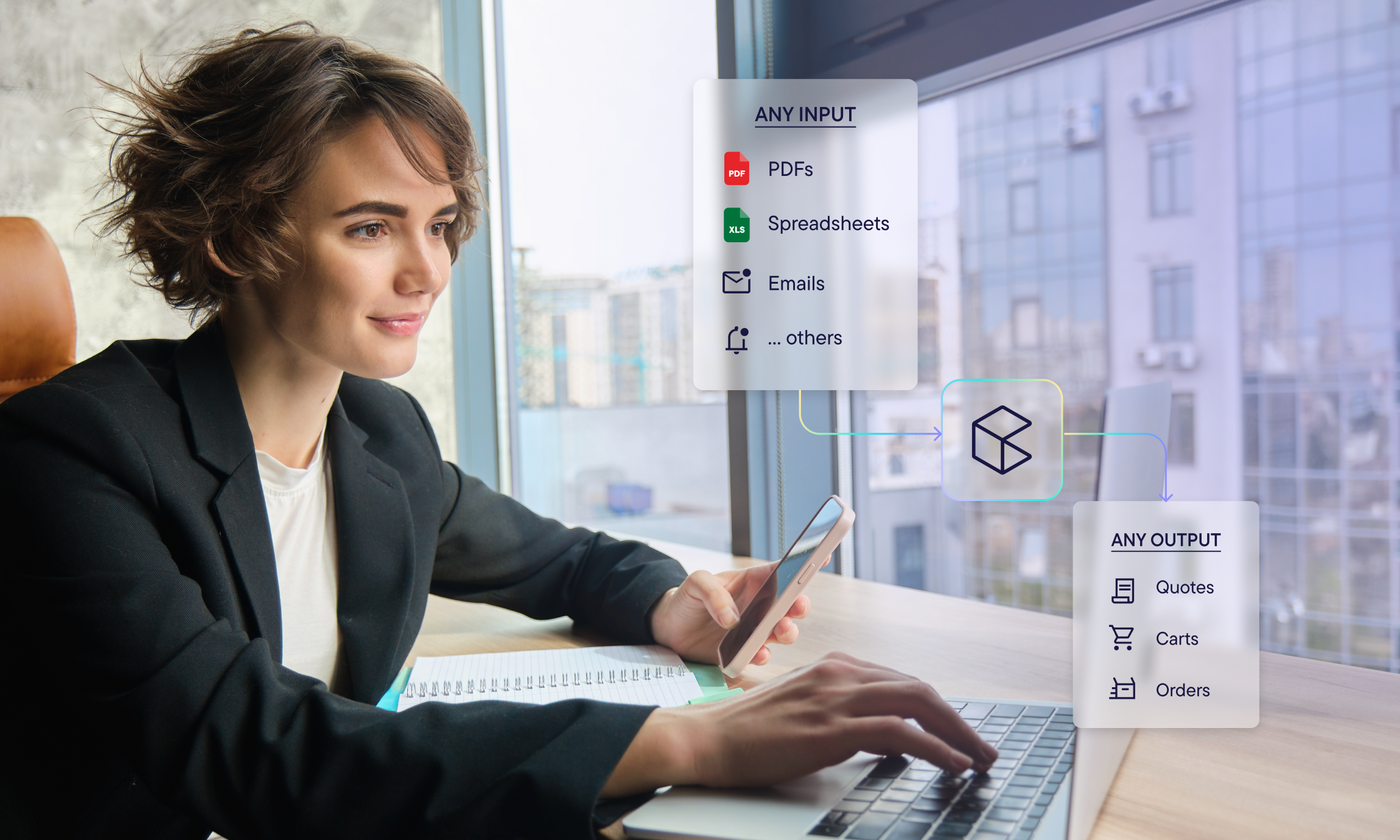
The commercetools B2B Intake Agent is an AI agent that converts unstructured buyer requests into structured quotes, carts or orders. A buyer can submit a request by:
The Intake Agent reads it, maps items to the correct product catalog entries, applies customer-specific pricing and generates a draft cart or quote ready for a rep to review and send.
What this does:
Who it’s best for:
Second, Assisted Selling removes friction by enabling sales reps to step into a live cart and support conversion when an order stalls. Reps can answer questions, apply additional discounts and resolve validation issues in real-time.
How commercetools’ Assisted Selling solves intake friction
In commercetools’ Merchant Center, sales reps can use Assisted Selling to view and lock active carts, resolve configuration issues and adjust the products, quantities or pricing on behalf of their customer. Buyers never need to restart the process — they simply let their rep step in. When the updated cart is ready, the rep can notify the buyer and answer any final questions before checkout.
What this does:
Who it’s best for:
A static eCommerce website isn’t enough on its own to reach today’s industrial buyer. The three-strand approach of self-service, rep-assisted and agent-assisted eCommerce helps manufacturers, distributors and wholesalers enable true omnichannel commerce, removing the friction that leads to cart abandonments.
This omnichannel selling approach turns frustrating, manual processes into streamlined, supported journeys. B2B manufacturers and distributors that adopt it can expect faster quote-to-order cycles, higher conversion rates and lower cart abandonment rates.
Cart abandonment is just one point in time in the customer relationship. The industrial buying lifecycle spans from pre-cart intent to cart building, order finalization, a wide array of purchasing processes and recurring orders. As industrial goods move into product lifecycle services, sellers need an infrastructure that enables rep-assisted and agentic commerce, enabling them to serve customers at scale without compromising expertise or service quality.
To succeed in this next era of B2B sales, B2B manufacturers, distributors and wholesalers need:
With this foundation, industrial B2B companies can turn unstructured demand into accurate carts and enable sales across the entire customer lifecycle.
Ready to see what commercetools can do? Contact our team to get started.
B2B manufacturers, distributors and wholesares often face cart abandonment due to complex product configurations, unstructured order data, negotiated pricing, approval workflows and lengthy order-finalization processes.
Hybrid selling combines self-service eCommerce, sales rep assistance and AI-powered support to help buyers complete complex purchases and reduce friction throughout the buying journey.
AI can automate order intake, convert unstructured requests into quotes or carts, recommend products and speed up order processing, helping buyers move to checkout faster.
Manufacturers, distributors and wholesalers can improve conversions by offering self-service purchasing, rep-assisted selling, AI-powered order intake and streamlined approval workflows.

Manuela leads content strategy at commercetools. With over 20 years of experience in B2B SaaS, she writes about all things commerce by day and turns to fiction by night. She loves long walks, traveling, and, unsurprisingly, reading books.
Receive monthly updates on trends, products and growth insights in your inbox.