

Get in touch
Stay informed
Receive monthly updates on trends, products and growth insights in your inbox.




For twenty years, the search box shaped how people found products online. You typed a few keywords, skimmed pages of results, clicked, compared, clicked again, and, eventually, made a decision. That model is fading faster than anyone expected.
Here’s what’s really happening: People aren’t typing keywords anymore; they’re expressing their search as natural conversations.
They’re describing needs in natural language. They’re asking questions the way they’d ask a salesperson. And large language models (LLMs) aren’t responding only with lists of links; they’re responding with answers, summaries, recommendations and actions.
Several signals make this shift undeniable:
In short, the front door of commerce is shifting from your website. It’s the AI conversation happening elsewhere.
But this shift isn’t just about how people search. It’s about what they expect from search. And that’s where the story gets bigger.

White Paper
Navigating the Agentic Commerce Era On Your Terms
The practical guide to help you approach agentic commerce strategically — not out of FOMO.
Once shoppers experience conversational discovery, their expectations are permanently altered. The bar rises, not slightly, but fundamentally, in the following ways:
The old query: men’s red running shoes uk 9.
The new query: I need durable running shoes for winter, size 9, budget around £120.
That’s not “search.” That’s problem-solving. A request for reasoning.
Shoppers don’t think in faceted filters. They think in trade-offs:
This requires inference and judgment, not a drop-down menu.
The traditional online shopping journey is full of small hurdles. A shopper starts with a search box, lands on a list of products, clicks on one, adds it to the cart, goes through checkout, enters details, pays and finally gets a confirmation.
It’s familiar, but it’s slow. And every step adds a chance for the shopper to drop off.
The conversational flow is completely different.
A shopper asks a question.
That’s it.
Ask → decide → buy.
One moment of intent.
One place where everything happens.
One clean outcome.
Shoppers are getting used to this simplicity in AI tools, and once they experience it, the traditional multi-step flow feels outdated and heavy.
“I’m going hiking next weekend.”
“I’m traveling to Iceland in December.”
“I want to start weight training.”
These are not product queries. They are goals. AI must make decisions on behalf of the shopper.
This creates a gap that traditional commerce systems can’t close.
The old commerce stack was built for a world where shoppers did all the work. They typed the keywords, clicked the filters, opened the product pages, added items to the cart and pushed the order through checkout.
Everything depended on the shopper driving the process step by step. But AI flips that model.
When a shopper says: “I need a good winter jacket for Iceland—keep it under £150.”
They’re not asking for a list of pages to click through.
They expect the system to:
All of that without forcing them through a long, manual flow.
Traditional commerce engines weren’t designed for this kind of behavior. They expect predictable inputs, clear steps and a human to make every decision along the way.
AI doesn’t work like that. It needs a way to “talk” to the commerce system directly, ask for data, take actions and complete tasks safely.
That’s why the industry needed a new standard. A clean, predictable way for AI agents to interact with product data, carts and checkout flows. And that standard is the Agentic Commerce Protocol (ACP).
The ACP created by OpenAI in partnership with Stripe, commercetools and other commerce leaders, is becoming the connective tissue between AI agents and digital storefronts.
At its core, ACP gives AI agents three abilities:
ACP is not a plugin or scraping. It’s a universal protocol, much like HTML was for browsers.
Think of ACP as three cooperating layers:
1. Discovery layer
Retailers submit structured product data, either through a feed, connector or platform like commercetools AI Hub. The key is clarity. AI agents perform best when working with catalog data that’s trustworthy, enriched and consistent.
2. Action layer
ACP introduces a set of standard functions that all agents are familiar with. Instead of building custom APIs for each AI platform, merchants expose one uniform set.
3. Trust layer
Every action is governed by policies:
This is how AI becomes both powerful and safe. ACP is the missing link that enables AI to transition from answering questions to completing purchases.
The most transformative aspect of ACP is Instant Checkout, a payment flow that’s handled entirely within ChatGPT, eliminating the need to redirect shoppers to a website.
Here’s the end-to-end flow:
And the shopper never leaves the conversation.
This eliminates:
If discovery happens inside AI, checkout must too. Otherwise, the buyer drops out.
The first wave of conversational commerce failed because chatbots were reactive. They waited for prompts. They couldn’t reason. They couldn’t act.
LLMs + ACP + Instant Checkout create an entirely new model.
Agents now can:
This is not replacing the website. It’s replacing the journey.
For years, commerce teams organized everything around channels:Your website, your mobile app, your marketplace listings and your ads. Each channel had its own strategy, its own analytics, and its own funnel.
That mental model no longer holds.
AI has turned any place where a shopper expresses intent into a potential buying moment.
Shoppers now ask real questions in tools like:
These aren’t “channels” in the traditional sense. They don’t look like storefronts. There’s no homepage or navigation menu. The entire experience is a conversation that starts wherever the shopper happens to be.
What this means is simple: Commerce now lives on surfaces, not channels.
A surface is any interface where a shopper expresses intent and expects a helpful, actionable response.
It might be a chat window, a voice prompt or an embedded assistant inside a productivity tool. If the shopper reveals their intent, that’s where discovery and buying begin.
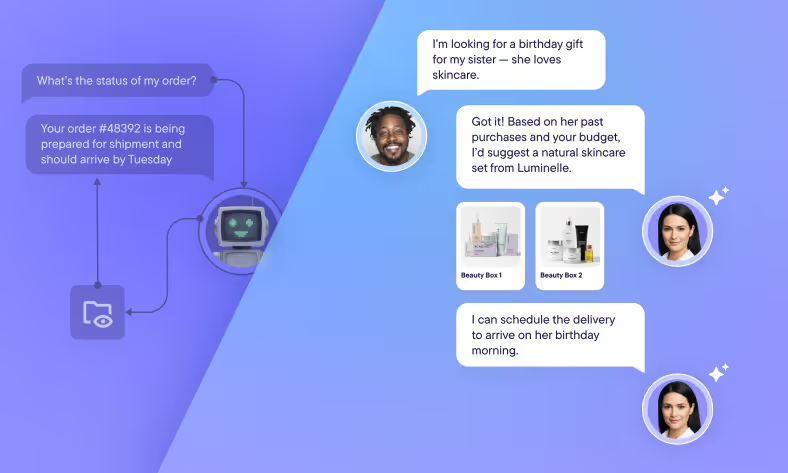
The shopper can say, “Build a full skincare routine for dry skin under £200.”
The agent:
This isn’t conversational commerce anymore. This is agentic commerce.
As shoppers move from keyword searches to conversational intent, a new requirement emerges: Brands must make their products understandable and actionable for AI agents. This is the foundation of AIO, or AI Interaction Optimization.
AIO is the discipline of ensuring that AI systems can:
To succeed in AI-driven discovery, three key capabilities are most important:
This is why platforms like commercetools AI Hub matter; merchants need one unified system to distribute, enrich, and manage product data across all AI surfaces.
Here’s the practical roadmap:
We’re moving from a world where people search for products to a world where products meet people inside conversations.
AI agents:
The search box marked the end of an old era of commerce. ACP, AI Hub and agentic interactions define the next one. We’re entering the post-search world — and the brands that prepare now will own the conversation later.
White Paper
Navigating the Agentic Commerce Era On Your Terms
The practical guide to help you approach agentic commerce strategically — not out of FOMO.

With over a decade of experience in identity, commerce, and platform strategy, Saurabh Saxena is a seasoned product marketing leader passionate about building future-ready digital ecosystems. At commercetools, he is driving innovation at the intersection of composable commerce and platforms.
Receive monthly updates on trends, products and growth insights in your inbox.