

Get in touch
Stay informed
Receive monthly updates on trends, products and growth insights in your inbox.





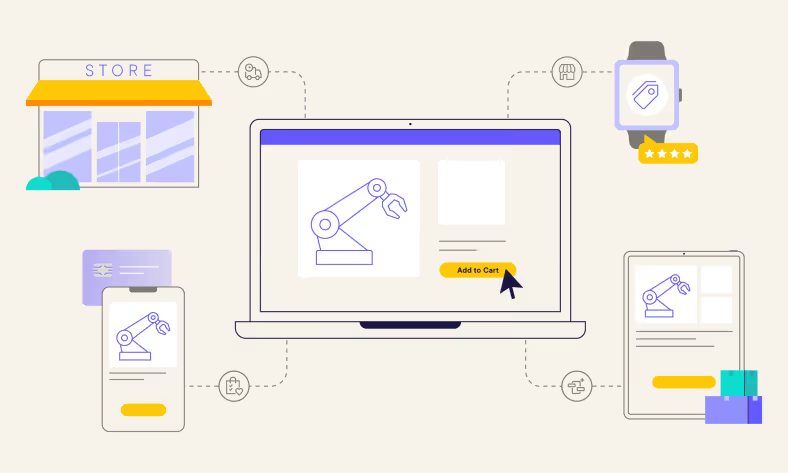
Businesses no longer have to choose a single way to sell. An industrial manufacturer might sell products to distributors, serve consumers directly through its own online store, and work with retail partners to reach additional customers. Each route to market creates different requirements for pricing, customer experience, order management and technology.
This raises an important question: Should each business model have its own commerce platform, or can multiple models run on a shared foundation?
The answer depends on the business’ requirements. A unified commerce platform can support multiple models, but it must accommodate their differences rather than treating every transaction and customer alike.
Here are the key questions to consider when evaluating a multi-model commerce strategy.
B2B, B2C, D2C and B2B2C are four business models that describe how companies sell products or services and reach their customers. The main difference is who the business sells to and whether it sells directly or through an intermediary.
The models can overlap. D2C is a form of direct B2C selling, while B2B2C introduces an additional business relationship between the supplier and the consumer.
The important distinction isn’t just who places the order, but how the business reaches the customer, who participates in the transaction, which party owns or manages the customer relationship, and how the commercial arrangement works.
Although the routes to market differ, they share many underlying commerce needs. Businesses operating B2B, B2C, D2C or B2B2C models generally need to manage product catalog, pricing, inventory, orders, payments, customer experiences and integrations with other business systems.
For instance, a manufacturer selling to both distributors and consumers can maintain a common product foundation while presenting different data and purchasing options to each audience. This unified approach to data is important for shared visibility into inventory availability and order status.
The opportunity is to reuse capabilities where the requirements overlap, without removing the flexibility needed for each business model.
Yes, one platform can support multiple business models if it can accommodate their distinct requirements.
A business selling to consumers might need promotional pricing, product recommendations and a streamlined checkout. B2B sales, however, might require negotiated pricing, company accounts, bulk ordering, purchase orders and approval workflows. Its D2C channel may share much of the B2C experience but require a direct customer relationship and a brand-owned storefront.
A shared platform can provide common commerce capabilities while supporting different rules and experiences for each channel or audience. The key is to distinguish between what should be shared and what must remain specific to a business model.
Common capabilities might include:
Model-specific capabilities might include:
Not every platform supports these requirements equally well. Businesses should evaluate the actual capabilities and configuration needed rather than assume that a platform can handle every model simply because it supports multiple storefronts.
The right architecture depends on how different the business models are, what systems are already in place and how much flexibility the business needs.
A unified commerce approach can reduce duplication by allowing business models to share commerce capabilities. It may also make it easier to introduce new channels, maintain consistent product information and coordinate improvements across the business.
Separate platforms can still make sense when business units have substantially different requirements, existing systems are difficult to replace or operational constraints make consolidation impractical.
The decision should consider more than the initial platform cost.
Importantly, a unified platform doesn’t mean a single, identical storefront for everyone. It means using shared capabilities where appropriate while preserving the differences required by each business.
Start with business requirements rather than with the platform configuration.
Identify who buys, who sells, who participates in each transaction and what each audience needs to complete a purchase.
For B2B, this may include account-based pricing, multiple buyers within an organization, approvals and repeat orders. For B2C or D2C, it may include product discovery, promotions, checkout and customer self-service. For B2B2C, document the roles of the partner and the business serving the end customer.
Look for common foundations, such as product data, inventory information, order processing and integrations. Avoid duplicating these capabilities without a clear business reason.
At the same time, don’t assume that every process should be identical. A shared product catalog, for example, may need different assortments, attributes or visibility rules for different audiences.
Document pricing, promotions, permissions, payment options, fulfillment and customer-account requirements for each model. This step is especially important when multiple models use the same product data or order infrastructure. Shared capabilities must still enforce the correct commercial rules for each transaction.
A composable commerce approach can help businesses combine commerce capabilities with other systems they need, rather than relying on a single rigid, all-in-one application for every requirement. The objective is to give teams the flexibility to evolve individual experiences and business capabilities while maintaining the connections between them.
The right architecture depends on the complexity of the business, the existing technology landscape and the capabilities that need to be shared.
A business doesn’t necessarily need to migrate every channel at once; it can prioritize the use cases with the clearest business value, validate the integrations and workflows and expand as the approach proves effective.
Testing should cover the storefront, pricing accuracy, order handling, account permissions, payment rules and downstream system integration.
B2X commerce is an approach to supporting multiple business-to-customer models, such as B2B, B2C, D2C and B2B2C, through a common commerce foundation.
Rather than building a completely separate commerce stack for each route to market, a B2X strategy seeks opportunities to share core capabilities while adapting experiences, rules and workflows to each audience’s needs.
The value of B2X isn’t that all business models become the same, but that a business can manage its similarities and differences deliberately.
For one organization, that may mean supporting a B2B portal and a consumer storefront with shared product and order services. For another, it may mean connecting direct sales and partner channels while keeping their commercial and customer-facing processes distinct.
B2X is therefore a strategic and architectural approach, not a guarantee that every model will fit every platform. The platform still needs to meet the business’s functional, integration, governance and scalability requirements.
A unified approach is worth evaluating when a business operates or plans to operate, multiple routes to market and those routes share meaningful commerce requirements.
It may be particularly relevant when teams are duplicating product data, integrations or order capabilities across platforms; when the business wants to introduce new channels; or when it needs a clearer view of performance across its commerce operations.
Before committing, assess:
The answers help determine whether a unified platform will simplify operations and support growth — or whether a more distributed architecture is appropriate.
B2B, B2C, D2C and B2B2C describe different routes to market, each with its own customer relationships, purchasing processes and operational requirements. Yet they also share many underlying commerce needs.
A unified B2X approach can help businesses reuse common capabilities while supporting the experiences and rules required by each model. Success depends on understanding those requirements, choosing an architecture that can accommodate them, and measuring outcomes in the context of each business.

White Paper
The Unified Commerce Playbook for Retail Leaders
Discover how brands and retailers can unlock the benefits of unified commerce.

Manuela leads content strategy at commercetools. With over 20 years of experience in B2B SaaS, she writes about all things commerce by day and turns to fiction by night. She loves long walks, traveling, and, unsurprisingly, reading books.
Receive monthly updates on trends, products and growth insights in your inbox.