

Get in touch
Stay informed
Receive monthly updates on trends, products and growth insights in your inbox.




While the conversation about AI in commerce has been primarily focused on consumer shopping, there’s another shift underway that’s not as headline-worthy but equally important: How enterprises modernize their commerce technology.
Commerce modernization has been at the top of the agenda for most enterprises, as many acknowledge that their legacy platforms have hit the ceiling and can no longer support their business growth. But a large portion of leaders remain skeptical about kickstarting a process that may require bottomless budgets and take years to complete.
A recent Forrester survey echoes this sentiment: It revealed that 70% of software decision-makers in B2C and 60% in B2B say they aren’t planning to change their current commerce provider.
Then comes AI. We all know that applying AI can be transformative in many ways, including the much-talked-about agentic shopping and the emerging autonomous commerce. When it comes to enterprise commerce modernization, replatforming or digital transformation — whatever you decide to call it — AI is already lowering implementation costs and barriers that prevented enterprises from bringing their commerce to the next level.
In this article, let’s explore what’s really behind the complexities of enterprise commerce modernization, and how commercetools for Builders is evolving to help you tackle these challenges.
Commerce complexity is not only measured by traffic volume. Enterprises have many other variables that they have to account for: Multiple brands, countries, currencies, tax and legal regimes, languages, channels, often both B2B and B2C models — each with its own catalog, pricing and fulfillment logic. All of those are expected to coexist in one coherent system rather than as disconnected instances nobody can reconcile.
A mid-market business typically runs one brand, one or two markets, and one selling model on largely out-of-the-box processes. An enterprise has to bend the commerce layer around systems of record and org structures that already exist, while meeting governance, uptime and security requirements.
Migrating off a legacy platform is a complex endeavor that involves many integrations, with most effort dedicated to reconciling ERP, OMS, PIM, CRM, tax, payments and fulfillment systems that each define product, price, order and customer differently. Then, take into account that the real requirements only surface throughout the build, because they live in business processes and organizational silos, not in the RFP.
Long story short, enterprises have been stuck choosing between speed to market and enterprise-grade depth. That trade-off was a byproduct of how implementations have historically been built, which have inevitably left many leaders skeptical about the real benefits of modernization or replatforming initiatives.
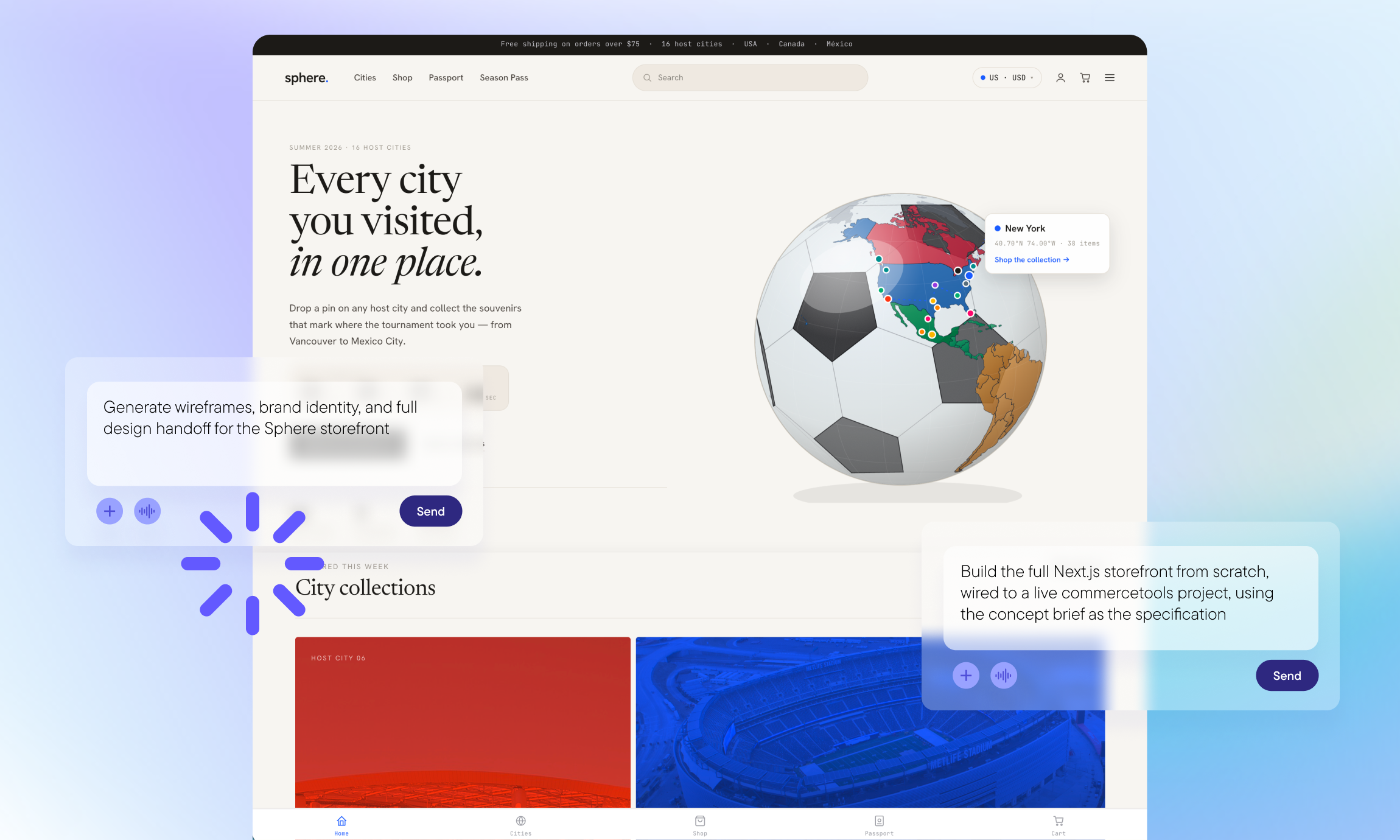
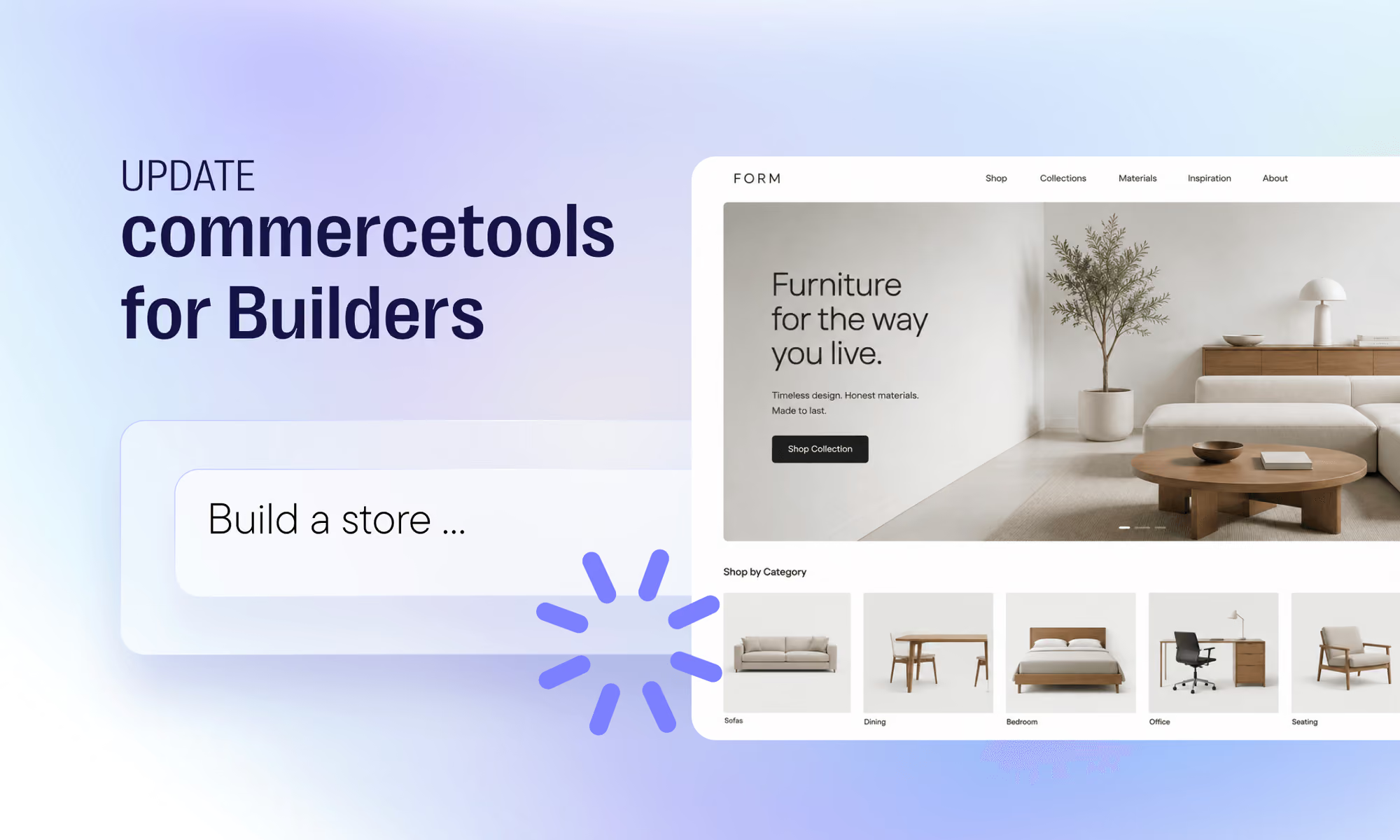
commercetools for Builders was launched in June 2026 to close that gap by working directly inside the tools engineering teams already use: Cursor, Claude Code and the rest of the modern dev workflow. It’s an ever-growing library of AI skills and tools that turns intent into production-ready commerce, spanning integration, admin, deep domain work, migration and more, with new capabilities arriving every release.
Crucially, commercetools for Builders uses the same Sphere platform, the same APIs and the same certifications that enterprises already rely on. The skills change how you get there — they don’t change what you get to.
Importantly, the focus here isn’t about AI writing code. Rather, AI is becoming a catalyst for teams to amplify their creativity and strategic thinking, using it to build solutions, validate results from multiple angles, and free engineers to focus on the business logic that’s unique to that customer journey.
The payoff shows up twice: Standard eCommerce functionality gets implemented in a fraction of the time it used to take, and the time that’s freed up goes toward the parts of the platform that differentiate the business.
That distinction is also where commercetools for Builders is heading next. What started with foundational capabilities and a faster way to create a digital storefront is evolving into something broader: a way to reduce complexity and enable enterprises to further modernize - developing integrations, supporting different types of workflows, and focusing on true business differentiation.
Accelerating digital storefront creation delivers tangible value, but does not reduce the real complexity of the surrounding ecosystem, which still has to be wired and assembled. The greater value lies in what lies beyond the storefront — the system integration required to bring enterprise commerce to life, and where time-to-live is really eroded. That’s why we are now releasing Integrations, the second part of the commercetools for Builders library, following our Foundations release earlier.
With this fresh expansion, commercetools for Builders now follows the arc of a real project implementation:
The core building blocks to start a commercetools implementation correctly the first time: checkout, storefront, and functional commerce modeling. Skills for project set-up, authentication and security governance will follow later.
Skills covering the connection between commercetools and every system a business already runs: Payments, tax, order management, PIM, CRM, promotions, email, gift cards, search, analytics, marketplace and more.
Expect more action about the Commerce Integration Layer, which is also coming soon.
Together, these groups mark the shift from help me build an initial storefront faster to help me solve the reasons modernization stalls.
Explore the skills we already have available in our commercetools for Builders library — and stay tuned for more!


Receive monthly updates on trends, products and growth insights in your inbox.