
.png)
Get in touch
Stay informed
Receive monthly updates on trends, products and growth insights in your inbox.



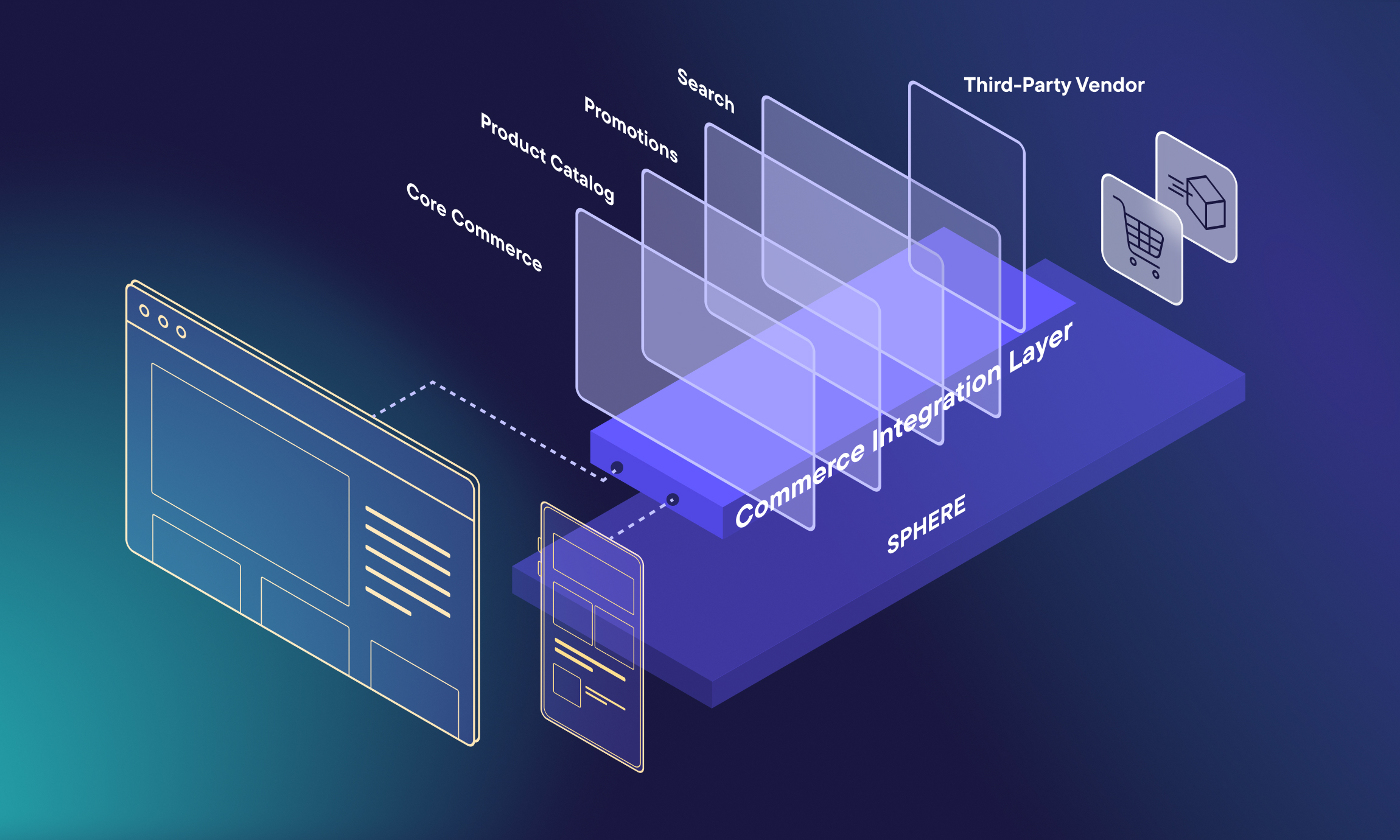

The best-performing commerce stacks are assembled from best-of-breed parts: A commerce engine, connected to a search provider, a promotions engine, tax, payments, content, and more. This flexibility is the whole point. But there’s a common issue in bringing this to life: Integrating those systems and ensuring they’re in sync, a step that’s often built from scratch on every single project.
It’s no wonder then that wiring commerce to connect all of those services is one of the most time-consuming parts of any implementation. It’s frequently cited as a major reason projects take months to complete.
Worse, the same work is reconstructed every time. Each customer-facing surface — web storefront, mobile app, AI agent — tends to get its own backend-for-frontend service, and each one stitches the same systems together in a slightly different way, leading to inefficiencies and overhead. It is undifferentiated work that sits on nobody’s product roadmap, yet it has to happen before any customer-visible feature is available.
For the business, these issues show up in three critical ways:
In short, every month spent on plumbing is a revenue impact you don’t get back.
Back in June, we announced the upcoming Commerce Integration Layer to solve these issues. Alongside commercetools for Builders, the Commerce Integration Layer accelerates implementations and, as a result, time-to-value.
This is possible because the Commerce Integration Layer centralizes integration logic behind customer-facing experiences. Storefronts, mobile apps and AI agents all connect the same way, on a unified layer hosted and maintained by commercetools. This means you can model your integrations once, and every experience or channel can be added on top without additional integration work.
Five capabilities are provided from day one:
What further sets the Layer apart is that it’s purpose-built and managed by commerce and cloud experts, eliminating all operational overhead. Plus, it’s included with commercetools Sphere at no extra cost, saving you from the hefty bills and custom builds required by alternatives.
Build the integration plumbing once. One integration path serves every experience, so engineering capacity shifts from rebuilding middleware to building what sets you apart. Our system integrator partners benefit as well, as they don’t have to build the same foundation for each client, and instead differentiate in vertical expertise, experience design and delivery.
Faster rollouts and faster results. Because commerce capabilities are baked into the Layer from the get-go, you can get everything integrated faster. As a result, you can launch initiatives, such as a new market expansion, in a fraction of the time it took before.
Save maintenance costs and upkeep. Because we host and maintain the layer, bundled with commercetools Sphere, you don’t have to worry or pay for middleware upkeep. You own the customizations within your integrations, not the entire infrastructure that supports them.
Every composable commerce project comes with the same hidden cost: The glue. Before a partner can build the experience a client is paying for, someone has to wire commercetools to search, content, tax and payments, then host that layer, keep it running and upgrade it. Most partners solve this with a starter kit they copy at the start of each project. It works, but every copy starts drifting from day one, and keeping it current becomes the client’s costs or the partner’s.
What the Commerce Integration Layer does is centralize the layer with commercetools, which takes care of orchestration via a single Experience API that, when extended with integration code, enables our partners to write using a type extension model. Whenever fixes or new capabilities are in place, they’re automatically integrated into every project.
For our partners, the benefits are clear: There’s no integration layer or BFF to create or operate, so they can focus on architectural decisions, vendor selection, project delivery, vertical expertise, and, of course, the customer experience.
Leading agencies such as IONA and Zaelab were granted early access to the Commerce Integration Layer and have begun building new projects with it.
In short, the Commerce Integration Layer gives our partners a stable base to build that expertise into reusable extensions, apps and vertical solutions, instead of rebuilding the same plumbing on every project.
Finally, it prepares partners for agentic commerce. With the upcoming Experience MCP, generated from the same Experience API the storefront uses, shopping agents and storefronts share one set of contracts, and no partner has to build and maintain that layer on their own.
Integration is crucial for every commerce program and, until now, it’s been solved on a case-by-case basis. Today, it’s possible to solve it once and centrally, changing the issues that led to lengthy and costly implementations.
Our recommendation: Treat the Commerce Integration Layer as a default in your next build — be it a new storefront, a replatform, a new market, brand or channel – with a date already committed. The Layer you create for that first experience becomes the blueprint for every experience that comes after, including the AI-driven ones still on your roadmap.
Ready to go deeper? Explore the Commerce Integration Layer. And keep an eye on the commercetools for Builders library: We’re working on a skill that will help your teams implement the layer itself, taking yet another slice out of your time-to-live.

Nils is a Staff Product Manager at commercetools. His mission: make building and integrating composable commerce projects as easy as ABC, even for the world’s largest enterprises.

Nicolas is Product Marketing Manager & Competitive Intelligence Lead at commercetools. He brings extensive experience in consumer and market intelligence across a variety of verticals, specializing in identifying key market and competitive trends to inform strategic business decisions and drive customer-centric strategies.
Receive monthly updates on trends, products and growth insights in your inbox.