

Get in touch
Stay informed
Receive monthly updates on trends, products and growth insights in your inbox.







For many businesses, the promise of running their entire commerce operations on a single platform has delivered good results. All-in-one commerce platforms can reduce upfront development costs, accelerate launches and make day-to-day operations easier to manage. For enterprises looking to get online quickly, that simplicity can be a real advantage.
But as commerce evolves, the requirements are changing. AI is moving beyond product recommendations, content generation and customer service toward something more ambitious: Systems that can make decisions and take action across business operations. This is autonomous commerce.
The challenge isn’t simply whether your platform offers AI functionality. In fact, most of them already do. The question is whether your systems can give AI the data, access and control it needs to coordinate increasingly complex workflows — and even act autonomously.
We’re entering a new phase of digital commerce in which AI is evolving from a tool that helps people work faster into a technology that can increasingly execute tasks and coordinate decisions across business systems with greater autonomy.
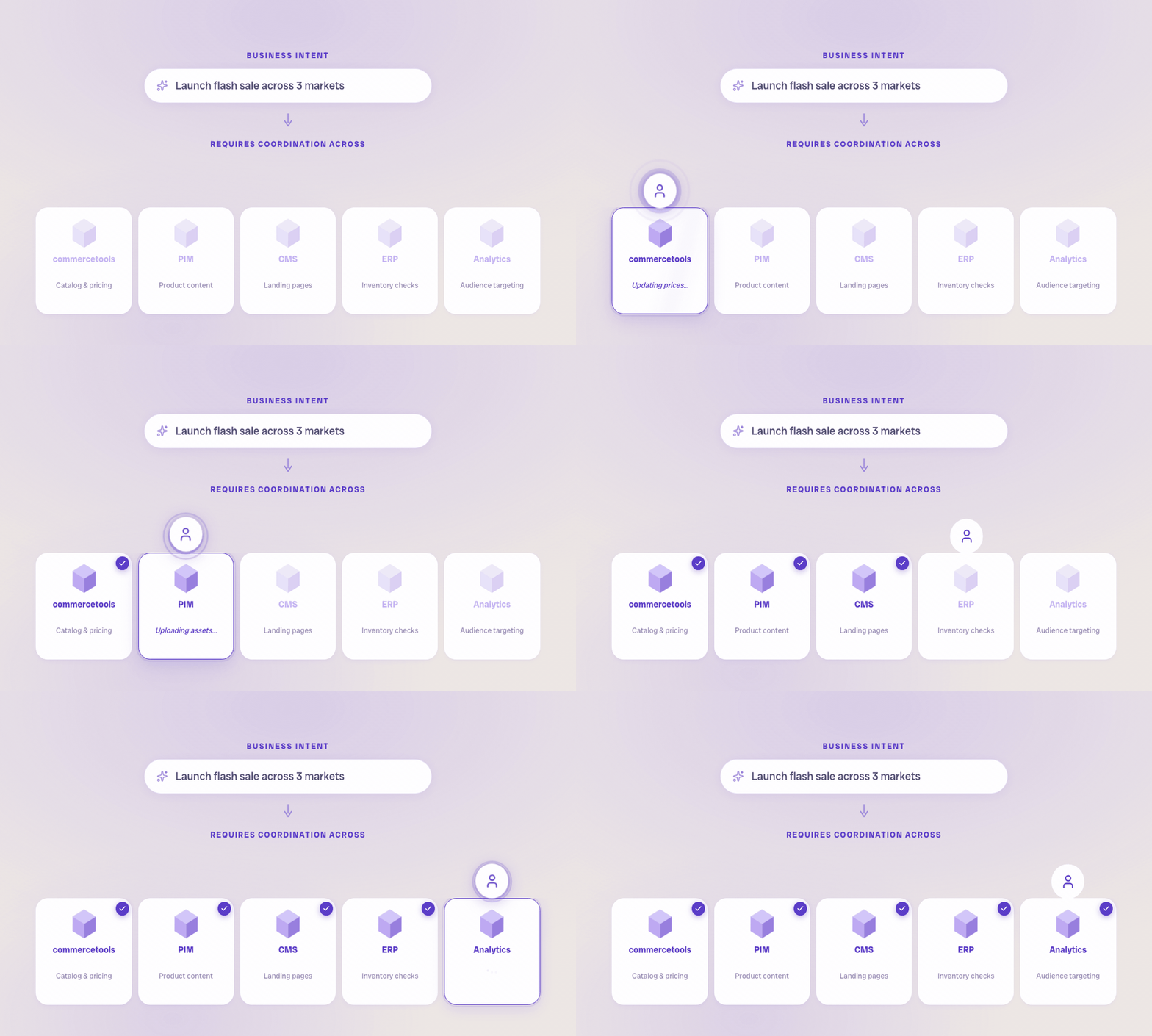
Imagine an AI agent detecting a sudden spike in demand for a popular product. To respond effectively, it needs to check available inventory, account for incoming stock and supplier lead times, assess profit margins and determine whether a pricing adjustment or promotion makes sense. It may then need to coordinate actions across inventory management, pricing, order management and marketing systems.
When these systems work together, the potential benefits are significant:
Customers benefit, too, through better product availability, more relevant experiences and faster fulfillment.
But moving from AI assistance to autonomous operations requires reliable access to business data, clearly defined actions and the ability to coordinate workflows across systems. In short, it’s the architecture behind your commerce operation that will influence how far you can take AI.
As mentioned earlier, all-in-one commerce platforms have made it easier than ever to launch and manage an online store. They offer integrated functionality, managed infrastructure and ecosystems of third-party apps, allowing businesses to get started without building everything themselves.
These advantages shouldn’t be underestimated. At the same time, the challenge arises when a business’s needs outgrow its initial setup.
Launching a commerce site in days rather than months is an attractive proposition. Drag-and-drop tools, prebuilt templates and integrated checkout functionality help brands get to market quickly without significant engineering investment.
A retailer may want to introduce a new payment method, implement a more sophisticated pricing strategy or customize checkout based on live inventory and fulfillment conditions. Whether it can do so depends on the platform’s extensibility, API capabilities and the degree of control it provides over core business logic.
The question goes beyond how easy and fast a platform can enable your commerce launch. What you should consider is whether that initial simplicity will continue to serve the business as its requirements evolve.
Need advanced search, a loyalty program or a new customer engagement tool? Third-party apps enable the extension of a commerce platform without developing every capability in-house.
Data can become fragmented across systems. Business rules may be duplicated, integrations may operate with different update frequencies, and workflows can become difficult to coordinate. Even when individual apps offer AI functionality, that doesn’t necessarily mean an AI agent can access the right information and execute actions across the entire technology stack.
Consider an agent tasked with recommending a promotion. It needs more than marketing data: It may also need current inventory, product costs, pricing constraints and fulfillment information. If those inputs are inconsistent or inaccessible, the agent’s decisions can be incomplete or inappropriate.
The real challenge is whether the underlying systems share reliable data and can coordinate actions when it matters.
All-in-one commerce platforms take much of the burden of infrastructure, security and scaling off your company’s shoulders. That can reduce operational overhead and help businesses maintain reliable storefronts during periods of high demand.
Businesses need to understand what automated systems are doing, monitor decisions, enforce business rules and intervene when necessary. They need appropriate permissions, clear audit trails and ways to handle failed or unexpected actions.
These requirements become increasingly important when AI moves from generating recommendations to changing prices, adjusting promotions or triggering operational workflows.
Autonomous commerce is opening the door to more coordinated decision-making across pricing, inventory, fulfillment and other business functions. For AI agents to run effectively within commerce operations, this foundation needs to be in place:
No single architectural approach guarantees these capabilities. They depend on the quality of the underlying systems, how they’re integrated and how the resulting workflows are designed.
Modular commerce is an architectural approach in which capabilities such as product catalogs, checkout, pricing and order management can be developed, extended and operated independently through well-defined interfaces, typically APIs.
Rather than relying on a single platform to provide all capabilities, businesses can select the components that best fit their needs and integrate them into a coherent commerce environment.
This approach requires more upfront planning than adopting a fully integrated solution. But for businesses with increasingly complex, enterprise-level operations, it offers several important advantages, including:
Modular architecture gives businesses greater control over how individual commerce capabilities are implemented and connected.
With well-designed APIs and clear interfaces, AI agents can access relevant information and invoke permitted actions across different systems. An agent might check inventory in one system, evaluate pricing rules in another and coordinate a promotion through a third, all within a governed workflow.
This doesn’t eliminate the need for integration or guarantee that every workflow can be automated. It does provide a foundation for connecting business capabilities without requiring every action to pass through a single application's predefined processes.
As AI capabilities evolve, your company can extend or replace individual components without necessarily rebuilding its entire commerce operation.
Modular commerce is sometimes associated with the challenge of managing numerous vendors, integrations and APIs. Poorly designed modular architectures can indeed create significant operational complexity.
With consistent data models, well-defined interfaces, effective orchestration and appropriate development tools, businesses can create a more coherent environment from independently managed capabilities.
The goal here is to give each capability a clear role, make the connections between systems reliable and ensure that business workflows can operate across them. This becomes particularly valuable when AI needs to coordinate decisions across multiple functions rather than operate within a single application.
The total cost of ownership will depend on implementation, licensing, integration and ongoing operations. But a well-designed modular approach can help your business avoid the cost and disruption of replacing or working around a platform that no longer meets your needs.
For many enterprises, the biggest barrier to modernization is the fear of a complete rebuild. Replacing an established commerce environment can mean significant investment, operational risk and years of work.
A modular approach doesn’t necessarily require starting from scratch. Businesses can retain existing systems that continue to deliver value while introducing new capabilities around them. An orchestration layer, for example, can connect an established ERP or finance system to newer commerce services, provided the necessary interfaces and controls are available.
Companies can then modernize incrementally, starting with the workflows that offer the greatest potential benefit. That might mean automating inventory-related decisions first, then expanding into pricing, promotions or fulfillment as the data, integrations and governance mature.
Commerce teams still need the same things they’ve always needed: Fast time to market, reliable operations, manageable costs and the flexibility to deliver experiences that differentiate their business.
As AI moves from assisting employees and customers to executing more complex operational workflows, you need to look beyond the feature set and understand whether your architecture can provide the data access, flexibility, coordination and control those workflows require.
For some businesses, an all-in-one platform will remain the right choice, and that’s okay. For enterprise-level businesses managing complex operations, modularity can offer a more adaptable foundation for connecting systems and introducing new capabilities over time, such as autonomous commerce.
Instead of asking only, How easy is it to get started? or What AI features does this platform offer?, you should also ask:
The answers will help determine how readily you can move from experimenting with AI to putting it to work across the business.
Ready to see what autonomous commerce looks like? Get in touch with our team for more details.
Autonomous commerce uses AI agents to make decisions and execute tasks across business systems, coordinating workflows such as pricing, inventory management, promotions and fulfillment.
AI agents need reliable access to business data, the ability to take permitted actions and coordination across systems. AI features alone cannot ensure effective end-to-end workflows.
Modular commerce connects independent capabilities through APIs, allowing AI agents to access information and coordinate actions across systems without relying on a single platform’s predefined processes.
All-in-one platforms can simplify implementation, but fragmented data, limited extensibility and disconnected workflows may make it harder for AI agents to access information and act across business systems.
Businesses should adopt an API-first foundation, ensure reliable data sharing, implement AI orchestration and establish governance through permissions, business rules, monitoring and human oversight where appropriate.

Manuela leads content strategy at commercetools. With over 20 years of experience in B2B SaaS, she writes about all things commerce by day and turns to fiction by night. She loves long walks, traveling, and, unsurprisingly, reading books.
Receive monthly updates on trends, products and growth insights in your inbox.